A Telegram investment scam rarely begins with an obvious request for money. It begins with a group that appears to have already earned everyone else’s trust.
There is an expert who seems to understand the market. Members post profitable trades all day. New investors thank the admin for helping them withdraw money. By the time you are asked to invest, the group has answered your doubts before you have expressed them.
That is the central trick. The scammers do not merely fake an investment platform. They fake an entire crowd around it.
In this blog, we discuss how fake Telegram investment/trading groups scam you out of money and what you can do if you have been scammed.
Key Takeaways
- The apparent popularity of a Telegram group may be manufactured by bots and planted accounts.
- A profit screenshot or dashboard balance is not proof that any investment exists.
- A small successful withdrawal may be designed to trigger a much larger deposit.
- Request for taxes or deposits before withdrawal are a major warning signs.
- Stop further payments, preserve the evidence and report financial fraud immediately.
The Group is the First Part of the Scam
A typical invitation arrives through an Instagram or Facebook advertisement, a YouTube comment, an unsolicited message or a link forwarded on WhatsApp.
The offer is made deliberately easy to accept. It can be anything like, “Join a free class”, “Receive tomorrow’s stock tip”, “Learn institutional investor trade”, “No payment is required yet”, etc.
Inside, the group looks more organised than expected. Market updates appear at regular times. The admin uses charts and financial terms confidently, A supposed assistant welcomes new members and helps them privately.
Then there are the success stories.
One member posts a ₹12,000 profit. Another claims to have received an IPO allotment. Someone shares a bank credit and says the withdrawal took five minutes. Questions about risk receive quick, reassuring replies.
The number of people agreeing with the admin creates credibility. But you have to way to know how many of those people are genuine. A scammer can operate several accounts, use bots or work with a team that follows a prepared script.
The group is not evidence that the investment works. The groups is a part of the sales pitch.
💡 Pro Tip: Ignore the member count for a moment. Ask what can be verified without relying on anything posted by the group itself.
How Telegram Trading Scams Turn Attention into a Deposit
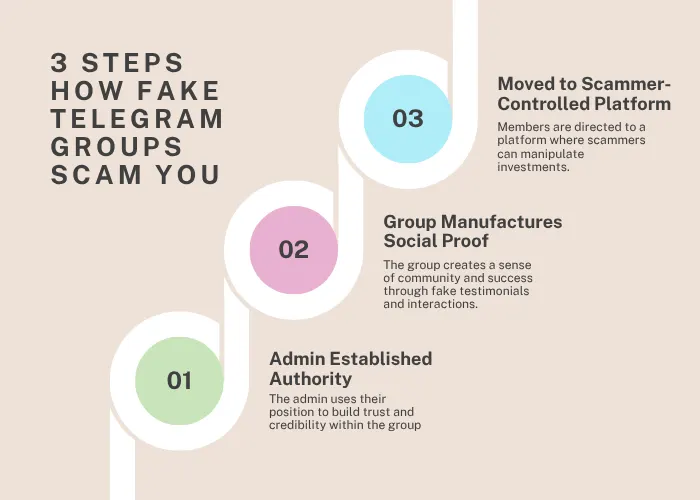
Most fake groups do not demand a large investment immediately. They move in smaller, more believable stages.
They can largely be categorised into three stages. Let’s understand them in detail.
First, the Admin Establishes Authority
The admin may pose as a trader, professor, portfolio manager, or representative of a known financial company. Profile photographs, logos, and registration certificates can be copied from genuine profiles.
Some admins spend days sharing free market commentary. A stock they mention may even rise, but that does not prove special access or skill. In an active market, a carefully selected winning call can be promoted while unsuccessful calls are deleted, edited, or quietly forgotten.
The important question is not whether one tip worked. It is whether the person is giving the advice is who they claim to be.
Then, the Group Manufactures Social Proof
Profit screenshots arrive faster. Members begin discussing larger deposits. The chat creates the impression that hesitation is the only thing separating you from the same returns.
This works because people naturally use the behaviour of others to judge an unfamiliar situation. A new investor may not know how to verify a trading platform, but they can see hundreds of people apparently using it.
That shortcut is exactly what the group exploits.
Screenshots do not solve the problem. Images can be edited, copied, or produced using fake payment apps. Even a real payment screenshot cannot show why the payment was made or whether the person posting it is independent of the admin,
Good online fraud awareness starts with separating what looks impressive from what can actually be checked.
Finally, You Are Moved to a Platform the Scammers Control
The admin introduces a private trading app or website. It may promise institutional prices, guaranteed IPO allotments, AI-assisted trades or access to opportunities unavailable through ordinary brokers.
After you deposit money, the dashboard begins showing profits. The numbers look precise. Stocks appear to have been bought and sold. Your balance may rise every day.
None of this proves that a trade took place.
On a fake platform, the scammers control the numbers on the screen. Your deposit may have gone directly to a mule bank account while the website displays an imaginary portfolio.
SEBI’s investor warning describes this pattern clearly; victims are recruited through social media groups, shown fake profiles, pressured to invest more and prevented from withdrawing.
Why a Small Withdrawal Can Be More Dangerous Than a Failed One
Some fake platforms allow the first withdrawal.
A person deposits ₹1,000, sees a profit and receives ₹1,300 back. That payment feels like confirmation that the app, the admin, and the group are genuine.
In reality, the ₹300 gain may be the bait that leads to a ₹30,000 or 13 lakh deposit.
The small payout changes the victim’s relationship with the scam. They are no longer acting only on a stranger’s promise. They have received money themselves. When friends question the platform, the victim can point to what appears to be personal proof.
This is why “I tested it and the withdrawal” is not enough. Verification must happen outside the system being tested.
💡 Pro Tip: Before increasing a deposit, verify the adviser, broker, app, and bank-account holder separately. Do not use links or phone numbers supplied by the Telegram admin.
The Profit Exists Until You Try to Withdraw It
The fake dashboard may show a healthy balance until you request a larger withdrawal.
Then a problem appears.
You are told to pay tax in advance. Your account needs a security deposit. A trading error must be corrected. Your credit score is too low. Commission has to be transferred separately.
The explanation changes, but the instruction remains the same: send more money.
A genuine financial platform does not require repeated transfers to unrelated accounts before returning your own funds. If charges are legitimate, they should be documented and handled through the regulated platform, not negotiated with a Telegram assistant.
The Indian Cyber Crime Coordination Centre (I4C) has warned that fake investment operations use social media advertisements, fraudulent apps, mule bank accounts, and small initial payouts to build trust.
Once a withdrawal is blocked and fresh money is demanded, stop immediately, Paying one more fee does not protect the earlier deposit. It only increases the loss.
The Numbers Show Why Fast Reporting Matters
This scam sits inside a much larger financial cybercrime problem.
According to a July 2024 response from the Ministry of Home Affairs, about 6.5 lakh cybercrime incidents were reported during the first four months of 2024. The figure covers several categories of cybercrime, not Telegram investment scams alone.
The same response said that India’s financial cyber-fraud reporting system had helped save more than ₹2,400 crore across over 7.6 lakh complaints since its launch in 2021.
In 2023, I4C also identified and recommended blocking more than 100 websites associated with organised investment and task-based fraud. According to the government, these scams used digital advertisements, messaging platforms, and rented accounts.
These are not Telegram-only figures, and they should not be presented as such. What they show is that fake investment platforms are organised, repeatable operations, not occasional tricks run by one dishonest admin.
A Five-Minute Check Before You Invest
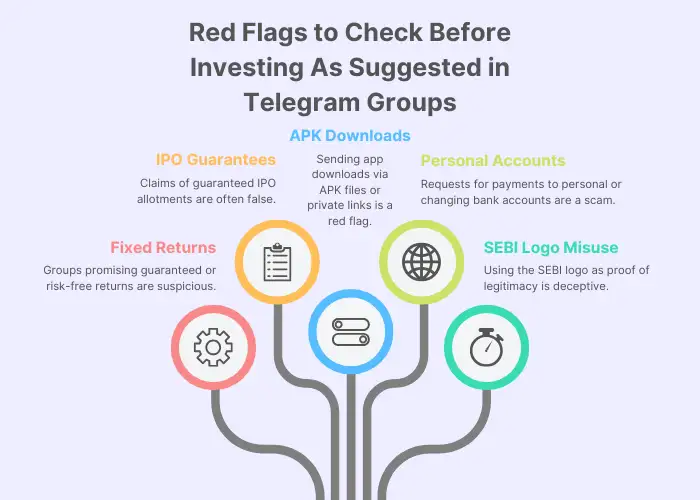
Pause if a Telegram group does any of the following:
- Promises fixed, guaranteed or risk-free returns
- Claims to guarantee IPO allotments
- Sends an app as an APK file or private download
- Asks for payments to personal or changing bank accounts
- Uses a SEBI logo as its main proof of legitimacy
- Pressured you to invest before a slot closes
- Prevents independent contact with the company being represented
- Demands a fresh payment before allowing a withdrawal
Check the adviser through SEBI’s official records. Confirm the trading app through the broker’s real website or relevant stock exchange. Contact the genuine company using the number you found independently.
What to Do if You Have Already Sent Money
Do not send another payment, even if the dashboard shows a much larger balance waiting for you.
Save the group link, admin usernames, full chat, payment instructions, transaction references, bank accounts, UPI IDs, website addresses, and app details. Record the withdrawal error and every request for an additional fee.
Contact your bank through the number in its official app or website. Tell them the transaction was connected to a fraud and ask whether the beneficiary account can be frozen.
Call the cyber crime helpline at 1930. Then file a complaint at cybercrime.gov.in. Our guide to the National Cyber Crime Reporting Portal explains what evidence to prepare and how the reporting process works.
If you need the steps in order, use this guide to report cyber crime without delaying the bank complaint.
If the payment involves a request inside GPay, PhonePe, or Paytm, check whether it was a UPI collect request or something else. Entering the UPI PIN sends money. It is never required to receive a payment.
Report the group to Telegram only after saving the evidence. Admins can remove members, delete messages, and quickly rename groups.
The Next Message Maybe Another Sam
Victims are often approached by people promising recovery,
The person may call themselves a lawyer, ethical hacker, police contact or crypto-recovery specialist. They may know the amount lost or the name of the platform. That information could have come from the original scammers.
Nobody can guarantee recovery for an advance fee. Do no provide OTPs, passwords, remote access to your phone or a crypto waller recovery phrase.
Use your bank, 1930, cybercrime.gov.in and the appropriate regulator. A private recovery promise can turn one loss into two.
FAQs: Telegram Investment Scam
Q1. How do I know whether a Telegram investment group is fake?
Guaranteed returns, private app links, unrelated payment accounts, and withdrawal fees are strong warning signs that the group is running a Telegram investment scam.
Q2. Are all Telegram trading groups scams?
No. Telegram in itself is only a communications platform. A group discussing markets is not automatically fraudulent. The risk rises sharply when anonymous admins provide investment advice, handle deposits, or direct members to an unverified platform.
Q3. Can a fake trading app show real-time profits?
Yes. A fake trading platform can display changing prices, completed trades, and growing balances. Those numbers may be generated by the website and may not represent assets held in your name.
Q4. Why did the platform allow my first withdrawal?
A small withdrawal can be used to build confidence. The scammers may return a little money because they expect the victim to make a much larger deposit afterwards.
Q5. Can money lost in a Telegram investment scam be recovered?
Recovery is guaranteed. The chances depend partly on how quickly the receiving account is reported and whether the money has already been moved. Contact your bank, call 1930 and file at cybercrime.gov.in immediately.
About the author
Rishabh Dev Choudhary writes and edits The Digital Big Brother. He isn’t a security engineer and doesn’t pretend to be — his work is reading government advisories, police notices, and reader reports, then rewriting them in language a nineteen-year-old will actually finish. Every scam example on this site is a reconstruction built from reported cases, and is labelled as one. More about the author →