
A crypto recovery scam usually starts with a hopeful message – “We found your stolen crypto. Pay a small fe and we will return it.”
If you receive a message like this, stop. Do not pay. A stranger on WhatsApp, Telegram, Instagram, or email cannot promise to recover your money.
Do not share your wallet password, recovery phrase, private key, OTP, or screen with the scammers. If the loss happened recently, quickly call 1930 and report it at cybercrime.gov.in.
Key Takeaways
- A crypto recover scam targets people who have already lost money once.
- Never pay a tax, deposit, gas fee, or processing charge to release the stolen crypto.
- Never share your recovery phrase, private key, password, OTP, or screen access.
- Report the fraud quickly through 1930, cybercrime.gov.in, your bank, and the crypto exchange involved.
- Crypto may sometimes be traced, but no private agent can guarantee that it will be returned.
What is a Crypto Recovery Scam?
Imagine that you lost ₹20,000 on a fake crypto trading app.
You post about it online because you are seeking help. A few hours later, someone sends you a private message.
They say they also lost money. Then they recommend a “trusted recovery expert” who helped them get everything back.
That expert may have a professional photo, hundreds of followers, customer reviews, and a Telegram channel filled with success stories. They may call themselves an ethical hacker, blockchain investigator, lawyer, exchange employee, or government-approved agent.
You may feel that help has finally arrived.
But this may be a crypto recovery scam.
The person pretending to be another victim may also be part of the fraud. The “expert” may be the same scammer using a different account.
This fake agent will promise to recover your money. But before returning it, they will ask you to pay a fee or share private account information.
The FBI warns that recovery scammers often pretend to represent law firms, private companies, and law enforcement agencies. Their real goal is to collect more money from people who have already suffered a loss.
💡 Pro Tip: Be extra careful when a stranger contacts you just after you post about losing money. Real authorities do not search social media for victims and promise recovery through private messages.
Why Do Scammers Target the Same Victim Twice?
After you lose money, you might feel scared, angry, embarrassed, or desperate. You will want to fix the situation before your family finds out.
Scammers understand these feelings and they use hope instead of fear.
The first scam says, “Send money and earn a profit.”
The second scam says, “Send money and recover your loss.”
Both lead to the same result.
This is why online fraud awareness is critical and should continue even after the first scam. A person who has already lost money may receive more calls, messages, and fake offers.
The recovery agent may know:
- Your name
- Your phone number
- The amount you lost
- The payment date
- The name of the fake platform
- Your wallet address
- Your transaction number
This can make the agent appear genuine. But the first scam group may have saved and shared your details. Scammers can also sell the list of previous victims.
💡 Pro Tip: Ask yourself, “How did this stranger find me? Unexpected contact is a warning sign, even when the person knows all accurate details.”
How Does A Crypto Recovery Scam Work?
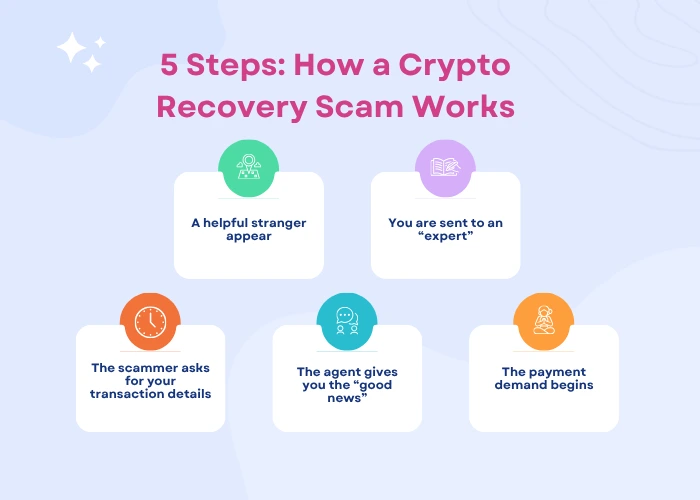
A crypto recovery scam on Telegram usually follows a predictable patterns.
Let’s discuss all the steps in which this scam operates:
1. A helpful stranger appears
The stranger claims to be another victim. They say a hacker, lawyer, or recovery company helped them get their money back.
They may send screenshots of their supposed refund.
However, those screenshots can be fake. The helpful stranger and recovery agent may also be the same person using two different accounts
2. You are sent to an “expert”
The expert may have a large Telegram group filled with fake customer reviews and success stories.
They may display:
- Police or government logo
- Company certificates
- Lawyer identity cards
- Screenshots of recovered money
- Photos of happy customers
- Technical-looking reports
- Thousands of followers
These things can be copied easily, edited, bought, or completely invented.
3. The agent asks for your transaction details
The agent (read scammer) may ask you to share your wallet address and transaction number.
Some crypto payment information can be viewed on a public record. The agent can look at the payment and repeat its amount or date to you.
This may sound impressive if you are unfamiliar with crypto. It does not prove that the person can recover anything.
4. The agent announces the good news
After a short wait, the agent says something like, “*Your funds have been located.*
They may send a long report filled with confusing words. They may also show you a website where your name appears beside a large “*recovered balance.”*
This report is meant to confuse you and the balance is meant to excite you.
5. The payment demand begins
Once all of this is done, the agent starts demanding for payment in the form of:
- An investigation fee
- A blockchain charge
- A government tax
- A security deposit
- A legal fee
- A wallet activation charge
- A gas fee
- A withdrawal charge
Now suppose you pay ₹3,000.
The agent then says the transfer is blocked and you need to pay another ₹5,000.
After that a new tax of ₹8,000 appears.
Every payment is described as the final one, but there is always another problem because there was never any real recovery.
🔔 Pro Tip: Write down the total amount being demanded. A “small” ₹2,000 fee can quickly become ₹20,000 through repeated requests.
Can You Trust a Recovered Balance Shown on a Website?
No. A number shown on an unknown website does not prove that your money has been recovered.
A scammer who controls a website can display any amount. They can add your name, a transaction animation, a countdown, and a working withdrawal button.
When you try to withdraw, a message may appear – “Deposit required before withdrawal”.
Do not pay.
SEBI has warned that fake trading apps show false profits to encourage more payments. When someone tries to withdraw, the scammer creates excuses or demand additional fees.
A fake recovery website uses the same trick. Instead of showing fake trading profits, it displays fake recovered funds.
In a crypto recovery scam, the balance exists only on the screen.
🔔 Pro Tip: Never deposit money into a website just to activate a withdrawal. If your funds were truly available, you would not ned to pay a stranger to prove that you own them.
What Are the Warning Signs of a Crypto Recovery Scam?
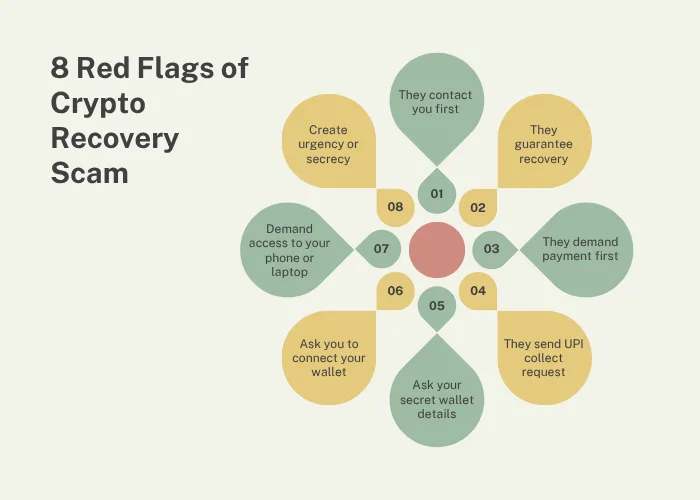
You do not need to understand blockchains or digital wallets to identify the danger. Focus on what the person promises and what they ask you to do.
Here are some of the common warning signs that signals a crypto recovery scam:
- They contact you first
- They guarantee that your money will return
- They demand payment first
- They send a UPI collect request
- They ask for your secret wallet details
- They ask you to connect your wallet
- They demand access to your phone or laptop
- They create urgency or secrecy
Now, let’s understand these signs in detail.
1. They contact first
Be cautious of who contacts your first. If a stranger who claims to know about your loss and offers help, be cautious.
Real police officers and government agencies do not promise private recovery through random Telegram or WhatsApp messages.
2. They guarantee recovery
Nobody can honestly promise a 100% recovery.
SEBI advises crypto investors to be suspicious of guaranteed results, quick returns, unregistered people, and high-pressure sales tactics.
The same rule applies to guaranteed loss recovery. A confident promise is not evidence.
3. They demand payment first
The agent may call the payment a refundable deposit, tax, retainer, gas fee, or processing charge.
But the name doesn’t matter.
If someone claims your money has been recovered, but says you must pay before receiving it, treat it as a crypto recovery scam.
4. They send a payment request on UPI app
A fake agent will say they are sending you a refund but actually send a UPI collect request.
A collect request asks you to pay money; it does not send money to you.
If GPay, PhonePe, Paytm, or your banking app asks for your UPI PIN, read the message carefully. Entering the PIN sends money out of your account.
💡 Pro Tip: If someone says, *“Enter your PIN to receive the refund”*, stop immediately. Contact your bank through the number on its official website or on the back of your bank card.
5. Ask your secret wallet details
Never share your recovery phrase, private key, password, or OTP.
A recovery phrase is usually a list of 12 or 24 words. Anyone who gets these words may be able to control your wallet.
No genuine customer support person needs them.
6. Ask you to connect your wallet
A fake website may ask you to press a button like “Connect Wallet” and approve a request.
That approval could allow someone to remove crypto from your wallet. Do not connect your wallet to a recovery link sent by a stranger.
7. Demand access to phone or laptop
The scammer may ask you to install AnyDesk, TeamViewer, or other such screen-sharing apps.
This can expose your messages, passwords, bank details, and crypto accounts. It may also allow the scammer to control your device.
8. Create urgency or secrecy
“You have 10 minutes”.
“The recover window will close today”.
“Do not tell your bank.”
These messages are designed to stop you from thinking or asking another person for help.
🎯 Pro Tip: Take a ten-minute break before sending money. Show the message to a trusted friend, parent, teacher, or bank employee. A second opinion can break the pressure created by the scammer.
How Serious is Online Financial Fraud in India?
At a government cyber-safety workshop in August 2026, experts cited 28.15 lakh cyber-fraud complaints and ₹22,495 crore in reported losses in India during 2025. They also said fake investment and trading scams were linked to 76% of the reported financial losses.
🎯 Pro Tip: Do not avoid reporting because the amount feels small. Your complaint may help connect several payments, phone numbers, wallets, or bank accounts to the same scam group.
Can Scammed Crypto Really be Recovered in India?
Sometimes stolen money can be frozen or recovered, but there is no guarantee.
Crypto payments may leave a visible record. Investigators may be able to see where the money moved.
Think of it like following footprints. Seeing the footprints may help an investigation, but it does not allow a private Telegram user to take the money back.
Real action may require help from:
- Cybercrime police
- Banks and payment services
- Crypto exchanges
- Courts
- Authorised investigating agencies
India’s Citizen Financial Cyber Fraud Reporting and Management System connects law enforcement agencies with banks, payment wallets, financial intermediaries, crypto exchanges, and other services. Its purpose includes quick action to stop stolen money from moving further.
Recovery depends on where the money went, whether the receiving account can be identified, and how quickly you report it.
Anyone who turns this possibility into a guarantee is making a common crypto recovery scam promise.
How Should You Report Cyber Crime After Losing Money?
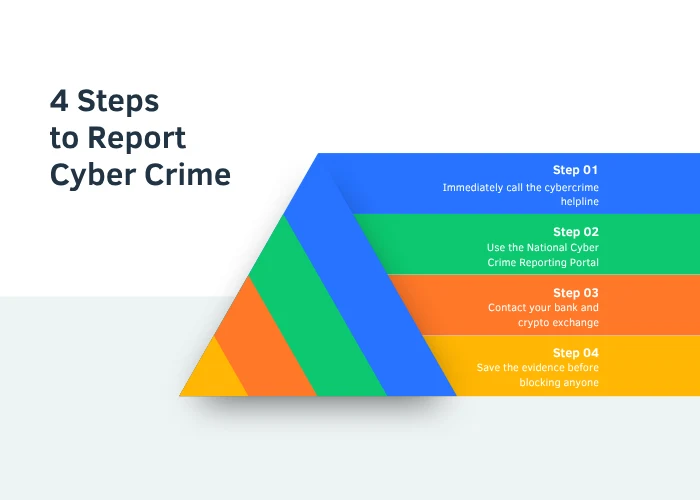
Once you recognise the warning signs, stop talking to the fake recovery agents and move to official reporting.
The following steps will help you report the cyber crime after you have lost your money:
- Immediately call the cybercrime helpline
- Use the National Cyber Crime Reporting Portal
- Contact your bank and crypto exchange
- Save the evidence before blocking anyone
Let’s understand them in detail below.
1. Call the cybercrime helpline at 1930
For financial fraud, call 1930 as quickly as possible.
Kerela police advices victims to call 1930 immediately because faster reporting increases the chances of freezing a fraudulent transaction.
Calling 1930 is free. A genuine police office will not demand a crypto payment to accept your complaint.
2. Use the National Cyber Crime Reporting Portal
You can report cyber crime through the official National Cyber Crime Reporting Portal.
Save the acknowledgement number you receive. If you first report the fraud by calling 1930, follow the instructions given to complete the online complaint.
Remember to provide:
- Your name and contact details
- The amount lost
- The date and time
- Bank or UPI transaction details
- Crypto transaction details
- Wallet addresses
- Phone numbers and usernames
- Screenshots of chats and payments
- Links to fake websites and profiles
Official reporting guidance asks financial-fraud victims to provide payment details, transaction information, and supporting screenshots when available.
Mention both the original fraud and the later crypto recovery scam.
NCERT cyber-safety material also advises victims to call 1930, file a complaint at cybercrime.gov.in, inform their bank or UPI app, preserve evidence, and avoid recovery offers.
🔔 Pro Tip: Create one folder for all screenshots, payment receipts, links, usernames, and transaction numbers. Clear evidence is easier to share with your bank, exchange, police, and other officials.
3. Contact your bank and crypto exchange
Tell your bank that the payment was connected to fraud.
If you used a crypto exchange, open its official website or app and contact support. Share the transaction number and receiving wallet address.
Ask whether the receiving account can be identified, marked, checked, or restricted.
Do not call a support number given by the scammer. Search for the official contact details yourself.
4. Save the evidence before blocking anyone
Keep copies of:
- Telegram or WhatsApp usernames
- Phone numbers
- Email addresses
- Wallet addresses
- Transaction numbers
- Bank and crypto payment receipts
- Website links
- Chat screenshots
- Fake certificates and identity cards
- Dates and amounts of every payment
Do not edit the screenshots. Keep the original messages if it is safe to do so.
Conclusion: Do Not Let Fake Promises Cause A Second Loss
Losing money can leave you desperate for a quick solution. A fake recovery agent understands this and uses your hope to target you again.
You do not need to understand blockchains, wallet tracing, or technical reports to protect yourself. Remember one simple rule:
If a stranger guarantees recovery and asks you to pay first, stop. It is probably a crypto recovery scam.
Do not send another payment. Save the messages, wallet addresses, transaction details, and screenshots. Call the cyber crime helpline at 1930 and use the official national cyber crime reporting portal at cybercrime.gov.in.
Being scammed once does not mean you were careless. What matters now is acting quickly, using help from official channels, and refusing to let a fake recovery promise case a second loss.
FAQs: Crypto Recovery Scam
Q1. What is a crypto recovery scam?
A crypto recovery scam tricks an earlier fraud victim into paying a fake agent who promises to recover their lost crypto.
Q2. How can I identify a fake crypto recovery agent?
Unexpected contact, guaranteed recovery, advance fees, and requests for wallet access are the main warning signs.
Q3. Is a crypto recovery Telegram agent genuine?
Treat any Telegram agent promising guaranteed crypto recovery or asking for payment first as a likely scammer.
Q4. Can I recover scammed crypto in India?
Recovery is not guaranteed, but quickly reporting through 1930, cybercrime.gov.in, your bank, and the exchange may help.
Q5. Where should I report a crypto recovery scam in India?
Call 1930, report it at cybercrime.gov.in, and immediately inform your bank, payment service, or crypto exchange.
About the author
Rishabh Dev Choudhary writes and edits The Digital Big Brother. He isn’t a security engineer and doesn’t pretend to be — his work is reading government advisories, police notices, and reader reports, then rewriting them in language a nineteen-year-old will actually finish. Every scam example on this site is a reconstruction built from reported cases, and is labelled as one. More about the author →