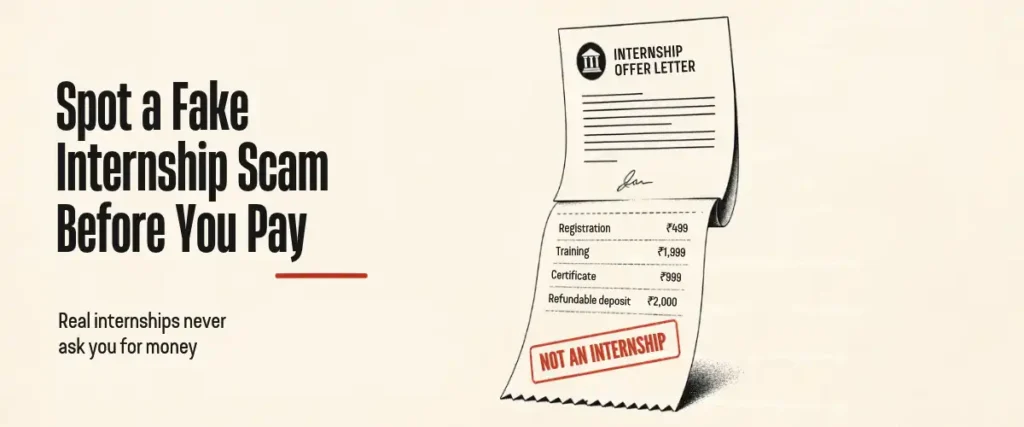
If an internship asks you to pay upfront, treat it as a fake internship scam, because genuine internships never charge students to apply, get selected, or start work. The reason is simple. A company takes on an intern to get real work done, so it covers the cost of training you and often pays you a monthly stipend. Money flows from the company to you, and not the other way round. When an offer asks for a registration, training, certification, or “refundable” deposit fee, that fee is the scammer’s profit, not a step in hiring.
This matters because internships are no longer optional for many Indian students. Credits and placement pressure push you to say yes fast, and fake offers are built around that rush.
Below, you’ll see why the “no fee” rule always holds, the names scammers use for the same payment, a five-minute checklist, and what to do if you already paid.
Key Takeaways
- A real internship either pays you a stipend or costs you nothing, it never charges you to join.
- Registration, training, certificate, and deposit fees are the same money requests with different labels.
- Even the government’s PM Internship Scheme charges no application fee and pays interns every month.
- A personal UPI ID, a Gmail address, or a payment QR code in an “offer” is a strong warning sign.
- If you already paid, call 1930 within the first hour, because speed decides how much can be stopped.
Why Does a Genuine Internship Never Need your Money?
The short answer comes down to who needs whom. Once you see how a real company thinks about interns, a fee request stops making sense.
The company needs your work, not your fee
Companies hire interns for real tasks, such as researching a market, drafting social media posts, fixing small bugs in code, or cleaning up data, etc. Training you costs a company time, because someone senior has to explain tasks and check your work. They accept that cost because they get useful work done and a close look at possible future hires.
A company that cannot afford to train an intern does not charge you for it. It simply does not hire one.
Some internships are unpaid, especially at NGOs or small startups. Unpaid means you are not paid. It never means you pay them. Government programs follow the same rule.
Government internship programmes are free as well
If anyone could justify a “processing fee”, it would be a huge government scheme. It doesn’t charge one.
The PM Internship Scheme, run by the Ministry of Corporate Affairs, has no application fee for any candidate, and selected interns receive a stipend of ₹5,000 every month for the full one-year internship.
So when a private “internship” asks for money that even a government scheme doesn’t, the fee *is* the business. That’s why scammers rarely call it a fee.
Registration Fee, Certificate Fee, Security Deposit: One Request, Many Names
Fraudsters rarely write “send us money.” They give the payment a name that sounds like routine paperwork. Here is how to read those labels.
| What they call it | What they say it’s for | What a real company does |
| Registration fee | “Confirm your slot” | Confirms you by email or offer letter, for free of cost |
| Training or course fee | “Skills you need before you start” | Trains you on the job at its own cost |
| Certificate fee | “Issues your internship certificate” | Gives the certificate for free when you finish |
| Security or refundable deposit | “Returned after completion” | Never takes deposit from interns |
| Software, laptop, or kit fee | “Tools for your project” | Gives you access or works with what you have |
These are not made-up examples. The CyberPeace Foundation has documented students being asked to pay ₹10,000 for a “certification course” before an internship could begin, and a ₹5,000 “screening fee” for an internship that the named brand knew nothing about.
Neither payment was called a fee for the internship itself. The label changes from offer to offer, but the direction of the money never does. One phrase, though, causes more confusion than the rest.
What does “paid internship” actually mean?
This phrase confuses many students, and some fake ads use that on purpose.
A paid internship means the company pays you a stipend (a fixed monthly amount for your work). Some fraud ads twist the phrase into a “paid internship programme” where you are the one paying. When you see “paid” in an ad, ask: whose bank account the money leaves from?
To see how these offers play out step-by-step, our Scam page on fake internship offers walk though a real example. Knowing the words helps, but it doesn’t explain why sharp students still get caught.
Why Careful Students Still End Up Paying
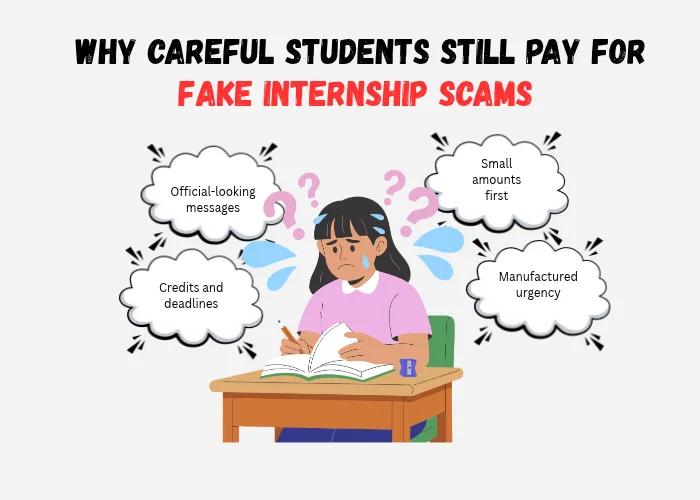
Losing money to a fake internship has nothing to do with being careless or “not smart enough”. These offers are built around pressures students already carry.
- Credits and deadlines: Many degree programmes now require an internship before you graduate. When a deadline is close, a sudden “you’re selected” email feels like relief, not risk.
- Official-looking messages: Fake offers often copy company logos, college names, or government-sounding titles. A neat PDF offer letter is easy to fake.
- Small first amounts: ₹99 or ₹499 feels too small to be a scam. It is often just the first of the several “fees.”
- Manufactured urgency: “Only 2 seats left, pay by tonight.” Pressure to pay *right now* exists to stop you asking anyone else.
This is why online fraud awareness is important. It protects you better than any app. Once you can name the pressure, it loses its grip, and you can turn that awareness into a quick check.
How to Check an Internship Offer in Five Minutes
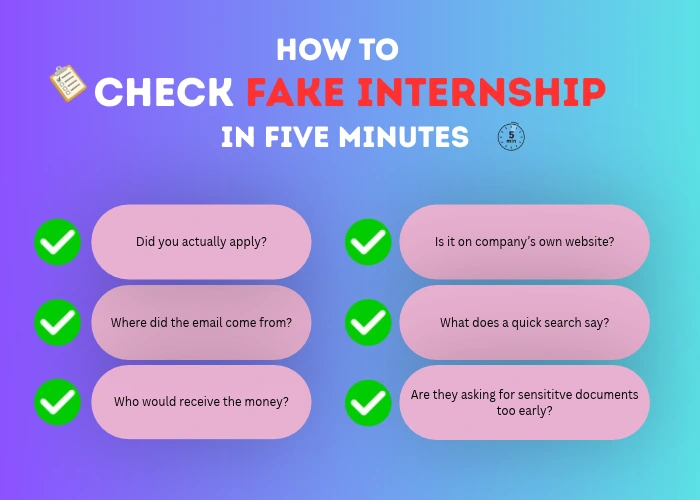
You don’t need technical skills for this. Run every offer through the following six questions before you reply or pay:
- Did you actually apply? A “Congratulations, you’re selected!” email for something you never applied to is a red flag on its own.
- Where did the email come from? Real companies usually write from their own domain (like name@company.com), not from Gmail, Yahoo, or Outlook addresses.
- Who would receive the money? A personal UPI ID or a QR code showing a person’s name is a classic fraud marker.
- Is it on the company’s own website? Open the company’s official careers page yourself in a fresh tab, instead of clicking links inside the email, and check whether the internship is listed there.
- What does a quick search say? Search the company name with words like “scam”, “fraud”, or “complaint”.
- Are they asking for sensitive documents too early? Aadhaar, PAN, or bank details before any interview is a warning sign.
Fail even one check? Pause and verify first.
💡 Pro Tip: Before paying any internship-related amount, forward the offer to your college’s placement cell and wait for their reply, because a genuine company will happily wait a day.
If you’re reading this after the money has already gone, here is what to do next.
Already Paid? What to Do in the First Few Hours
First, take a breath. You were targeted by people who do this full-time, and reporting quickly is the most useful thing you can do now.
The following are the steps that you should take within the “golden-hour” (within the first hour).
Step-by-step actions to take right away
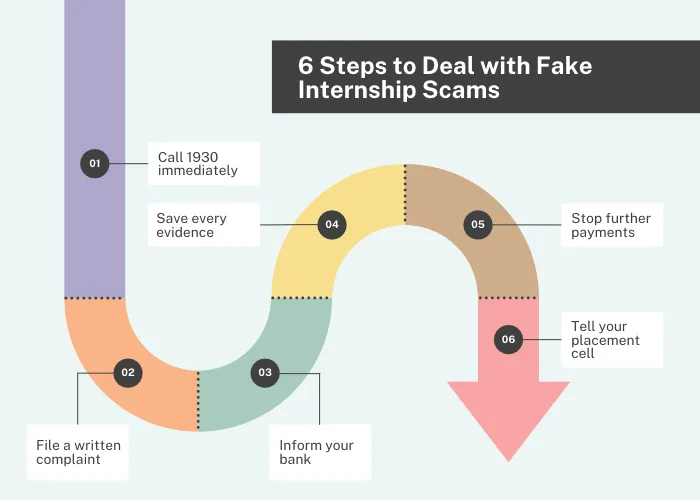
Do these in order, and don’t wait to see “if they reply.”
- Call 1930 immediately: The very first you should take is to call the national cyber crime helpline. Share the amount, time, the UPI ID you paid to, and the UPI transaction ID. Fast reporting gives banks a chance to track and freeze the money.
- File a written complaint on cyber crime portal: The second most important step is to report the case on the national cyber crime reporting portal – cybercrime.gov.in. Chose the financial fraud option and save your acknoweldgement number.
- Inform your bank: Next, you need to get in touch with your bank’s cyber fraud division and inform them the transaction.
- Save every evidence: Take screenshot of every chat you had with the scammer, their offer letter, emails, and the payment screen before anything gets deleted.
- Stop all further payments: Typically, scammers will send you payment requests in the form of “refund processing fee”, or “certificate release charge”. With immediate effect, put a stop on all further payments to the scammer, as they are asking for more payment, only the names of the payment requests change.
- Tell your placement cell: Lastly, inform your college’s placement cell about the scam, so they can warn other students.
Our guide on how to report cyber crime in India provides a full walkthrough the process and covers every step in detail. After reporting, most students ask the same thing: can I get the money back?
Can you get an internship fee refund?
Honestly, it’s possible but not guaranteed.
Under RBI rules, a customer has zero liability for an unauthorised electronic transfer if it is reported within three working days, and the bank must credit the amount within 10 working days of being told.
The keyword here is unauthorised, meaning a payment you did not approve. When you sent the internship fee yourself, your bank may treat it as an authorised payment, so this rule may not cover your case.
Recovery then depends on the police and the bank freezing the money in the scammer’s account before it moves, which is why the first hour matters. Be wary of anyone offering to “recover” your money for a fee, because that is a common second scam.
But, before you make any decision, check with your bank, police, or a legal professional, to get the best course of action depending on your specific situations.
Whatever the outcome, your complaint helps police connect cases and shut down the accounts these groups use.
📌 Lost money to an internship fee? Call 1930 now, then file a complaint at cybercrime.gov.in. Trusting an offer that was built to look real is nothing to be ashamed of.
Conclusion
Every genuine internship follows one simple rule: the company invests in you, not the other way round. Whether it’s a big company, a small startup, or a government scheme, you should never pay to apply, get selected, or receive a certificate. Any fee, whatever name it uses, is a signal to stop and verify.
Before saying yes to any offer, run the five-minute check and talk to your placement cell; a real opportunity will still be there tomorrow. If you’ve already paid, act fast, keep your evidence, and remember that being targeted says nothing bad about you. These groups count on silence, so speaking up takes the advantage back from them.
FAQs: Fake Internship Scam
Q1. Is it normal to pay for an internship certificate?
No. A genuine company issues your certificate free once you finish the internship. A “certificate fee” means you are buying paper, not experience.
Q2. Can an internship be unpaid and still be genuine?
Yes. Some NGOs, startups, and research projects offer unpaid internships. Unpaid means you don’t receive a stipend, but you should never have to pay them anything either.
Q3. Are internships listed on job websites always safe?
Not always. A listing on a popular site doesn’t prove an offer is real. If they ask for money, it’s a red flag wherever you found it.
Q4. What if the company says the fee is fully refundable?
A “refundable deposit”. is still a fee. Real companies never take deposits from interns, and the promise of a refund later is one the most common ways to make a payment feel safe.
Q5. I only lost ₹99. It is worth reporting?
Yes. It’s not about the money. Money, even in small payments, is how these groups test thousands of students at once. Calling 1930 or filing at cybercrime.gov.in helps police trace the accounts and protect the next student.