If you have been scammed, hacked, threatened, blackmailed, or cheated online, you can report it through the Indian government’s official National Cybercrime Reporting Portal at cybercrime.gov.in.
If you have lost money through UPI, a bank transfer, debit or credit card, or digital wallet, then immediately call 1930. The government’s cybercrime portal lists it as the Cyber Crime Helpline.
These are the two most important things to remember if you have been scammed online or a victim of any digital fraud.
You do not need to know which cyber crime law applies to your situation. You do not need to find out who the scammer really is. You also do not need to prepare a perfect complaint before asking for help.
You just have to start with the right channel, save whatever evidence you have, and explain what happened as clearly as you can.
Go deeper on either channel: read our full guides to what the National Cyber Crime Reporting Portal can and can’t do, or to when to call the 1930 helpline and what to expect.
Key Takeaways
- Call 1930 immediately if you have lost money through UPI, bank transfer, card, or another digital payment method.
- Use cybercrime.gov.in to file an official cyber crime complaint in India.
- Save screenshots, chats, phone numbers, payment details, and other evidence before deleting anything.
- Explain what happened in simple, clear words and include only information you know is correct.
- Keep your acknowledgement number safe so you can track your complaint later.
Before You Report Anything, Make Sure You Are On The Official Website
Once you have realised that you have been scammed, your first reaction might be to search Google for something like “cyber crime complaint number” or “how to recover scam money”.
Be careful.
You may come across unofficial websites or people offering you help to recover the stolen money. But, do not use them, instead just trust on the government’s website – cybercrime.gov.in.
The National Cybercrime Reporting Portal is an initiative of the Indian government for reporting cybercrime online. The website is managed by the Ministry of Home Affairs and covers different types of cybercrime, including online financial fraud, social-media crime, hacking, ransomware, and other online crimes.
How to Report Cybercrime in India: 7 Steps
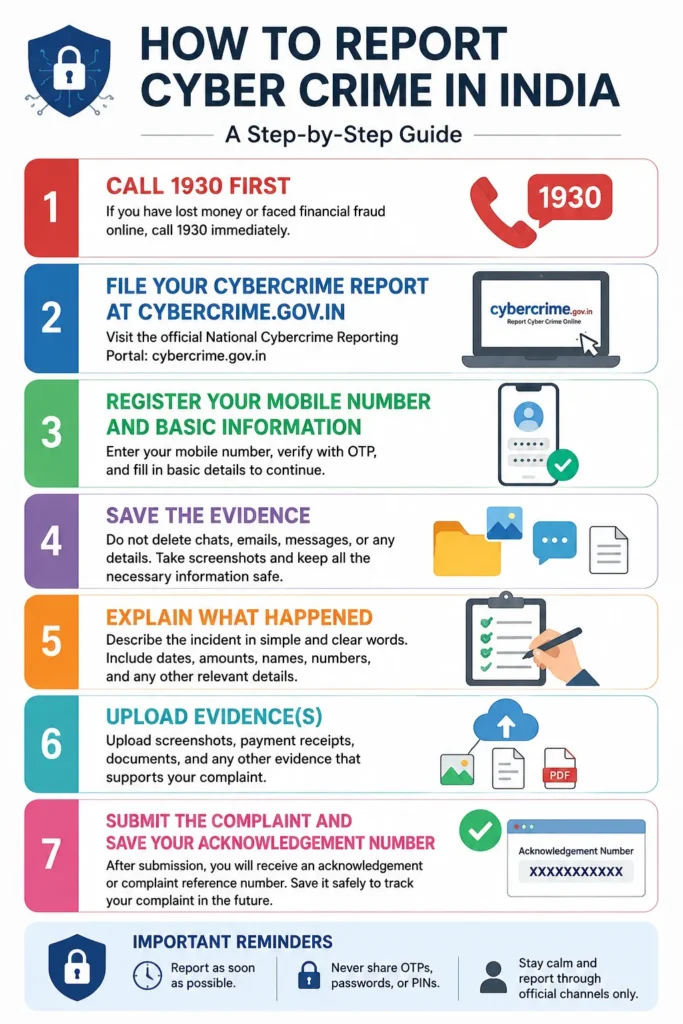
Cybercrimes are increasing rapidly across the country. The following are the 7 steps that you should follow if you have been scammed online.
1. If you have lost money, call 1930 first
One common online scam in India is related to jobs. Now, let’s suppose you receive a WhatsApp message offering you a part-time job. The sender asks you to complete some very simple tasks claiming them to be tests for the job. Then they ask you to pay ₹2000 to “activate” your account. You pay the asked amount, and a few minutes later, they ask you to pay ₹5000.
This is not normal, because to get a job, you should not have to pay even a single rupee. So, the moment you realize something is wrong, the first thing you should do is call 1930.
This is an important step when you have lost money through:
- UPI apps such as Google Pay, PhonePe, Paytm, etc.
- Bank transfers
- Debit or credit cards
- Digital wallets
- Fake job or internship offers
- Fake customer-care calls
- Impersonation scams
- Online blackmail or threats involving payments
What should you keep ready before calling 1930?
It is best to keep everything you have about the scam, ready. However, at the very least, you should keep the basic information handy.
For financial-fraud complaints, the cybercrime police will ask details including banking information, wallet, or merchant name, transaction ID or UTR number, date of transaction, and the amount you lost.
Although you should provide as much information as you can to the police, but also do not spend too much time collecting every screenshot before reporting the fraud.
Once you have reported the financial loss, you can then move on to lodging an online complaint.
2. File your cybercrime report at cybercrime.gov.in
Go to cybercrime.gov.in and select the option to register a complaint.
Currently, there are three types of complaints you can register – Women/Children Related Crime, Financial Fraud, and Other Cyber Crime. Depending on your situation, select the right option.
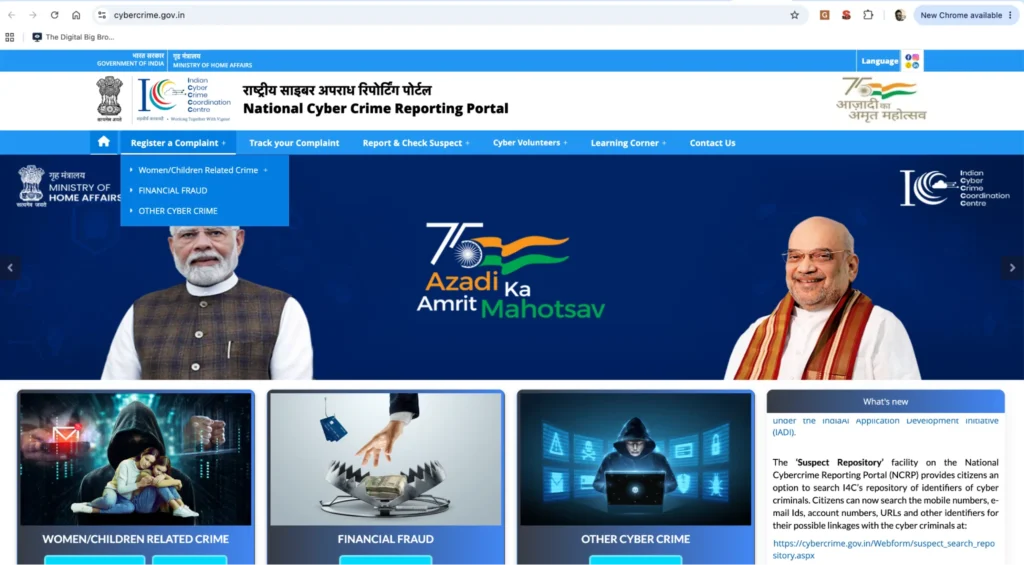
💡Note: You can report complaints about crimes involving online and social media, financial fraud, hacking, ransomware, cryptocurrency, and other cyber crimes.
Do not get stuck trying to decide whether your case is phishing, impersonation, identity theft, hacking, or something else.
Remember, you are reporting what happened to you, and therefore it is completely fine to not know how to classify the crime.
The most useful thing you can do here is to provide accurate information to the authorities so that they can make appropriate decisions.
3. Register your mobile number and basic information
To submit your complaint, you will first need to register using your name and a valid Indian mobile number.
The portal will then send an OTP to that number. After verification, you can select the relevant category and sub-category and continue with your complaint.
You might be comfortable using the website to register your complaint, but if your parents, grandparents, younger siblings, or friend has been scammed, they might struggle. The best thing you can do here is to just sit with them while they submit their complaint.
📝 Remember: Before you submit your complaint, there are some things that you should do first.
4. Save the evidence before your block or delete anything
It is common, and natural, to feel angry, scared, or embarrassed, once you find out that you have been cheated on.
Blocking the scammer is also a common first reaction. But, do not do that now.
You might want to delete the messages, but they might contain some useful information that can become evidence.
The National Cyber Crime Portal specifically lists things such as bank statements, money-transfer receipts, emails, chats, suspect’s mobile number screenshots, images, videos, etc. as evidence.
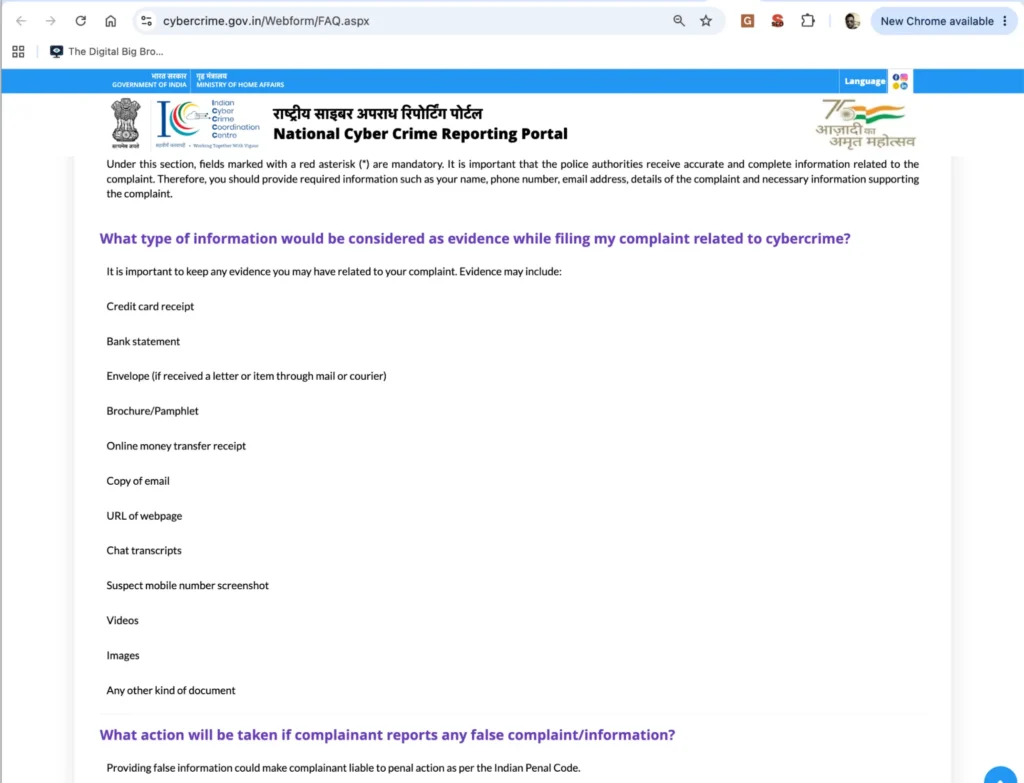
What evidence should you save?
Depending on what happened, keep:
- WhatsApp or Telegram chats
- SMS messages
- Emails
- Phone numbers
- Call details
- Instagram or Facebook profiles
- Social media usernames
- Website links
- UPI IDs
- QR codes
- Payment screenshots
- Bank transfer details
- Transaction IDs or UTR numbers
- Fake job offer letters
- Photos, videos, or voice recordings
You do not have to create a complicated investigation folder, you save what you already have.
For example, if someone offered you a ₹20,000-a-month internship and asked for a ₹1999 registration fee, then do not just save the payment screenshot.
Rather, save that message, phone number, company name they used, website or profile, payment request, and the conversation after you paid.
Together, these details can explain what happened much better.
Now you are ready to write the complaint itself.
5. Explain what happened in simple words
Many people freeze when they see a box asking them to describe the incident. Some find it difficult to explain, while for some it is like a trauma that they have to live through again. This can be pretty scary.
It is common and natural to think that a cybercrime complaint needs to sound like a legal document.
But in reality, it does not have to.
You can write something as simple as:
“I received a WhatsApp message from XYZ offering me a part-time job. They gave me some tasks and asked me to complete them. After I did that, they asked me to transfer ₹5,000 through UPI for registration. I paid that amount, and then they asked for another ₹10,000. I then realised that it could be a trap and decided to report it.”
This is a clear complaint listing out all the things that happened with you.
Submit whatever documents you saved along with this complaint.
Still not sure how to write your complaint?
If you are still unsure what to write, then answer the following:
- How did the person contact you?
- What did they claim or promise?
- What did they ask you to do?
- Did you send money or share information?
- What happened after that?
Include dates, amounts, phone numbers, or usernames where you can.
But, if you cannot remember them, then do not guess.
Your complaint should provide accurate and complete information so the authorities can understand your situation better and take appropriate action. The cybercrime portal recommends giving as much useful information as possible to the police and authorities.
6. Upload whatever evidence(s) you have to support your complaint
This is the part where you upload or submit whatever evidence(s) you gathered earlier.
Remember to attach the most useful evidence(s).
For example, if ₹8,000 was taken through UPI, you may have:
- The payment screenshot
- Transaction ID or UTR number
- UPI ID
- Transaction date and amount
- WhatsApp conversation
- Phone number(s) used by the person
As per the cybercrime portal’s current complaint checklist, users are required to keep the incident date and time, incident details, identification, relevant evidence, and specific transaction information ready.
But, do not worry if you do not have every possible piece of evidence.
Upload whatever you have, but just make sure it relates directly to your complaint.
Lastly, check the form once before submitting.
7. Submit the complaint and save your acknowledgement number
Before finally submitting the complaint, check and verify important details such as payment amounts, phone numbers, dates, UPI IDs, etc.
Remember: Instead of writing perfect English, focus on making sure the information is correct.
After you have submitted the complaint, you will get a complaint reference number by SMS and email. Save them!
You can use this acknowledgement number to track the complaint through the portal.
Take a screenshot of the number and save it.
You can also send it to yourself on WhatsApp or email so you have another copy.
Before You Close This Page
Reporting cyber crime can be confusing, especially when you are already dealing with the stress of losing money, or having an account hacked, or realising you have been tricked online.
But the process of reporting the crime becomes much easier when you take it one step at a time.
Start by calling 1930 if you have lost money online. Then go to cybercrime.gov.in, register your details, save the evidence, explain what happened in simple words, upload the proof you have, and keep your acknowledgement number handy after submitting the complaint.
Your job is simply to provide clear and accurate information to authorities about what happened. Do not delay reporting the crime because you feel embarrassed or unsure about whether your case is serious enough. If something has gone wrong online, saving the evidence and reporting it through the official channel is a sensible next step.
FAQs: Report Cyber Crime
Q1. Where can I report cyber crime online in India?
You can report cyber crime through the Government of India’s official National Cybercrime Reporting Portal at cybercrime.gov.in. The portal can be used for reporting different types of cybercrimes including financial fraud, social media related incidents, hacking, phishing, online job fraud, and other online offences. If your complaint involves lost money, then you should also call 1930 as quickly as possible.
Q2. What is the cyber crime helpline number in India?
The cyber crime helpline number for reporting financial fraud in India is 1930. You should call it if money has been taken through UPI, a bank transfer, debit or credit card, digital wallet, or another online payment method.
Q3. What documents or evidence do I need to report cyber crime?
The evidence depends on what happened. Useful information can include screenshots of chats, phone numbers, emails, social media profiles, website links, UPI IDs, payment receipts, bank transaction details, transaction IDs or UTR numbers, etc.
Q4. Can I report cyber crime if I do not know who the scammer is?
Yes. You do not need to know the scammer’s name, address, or location before filing a cyber crime report.
Q5. Can I track my cyber crime complaint after submitting it?
Yes. After submitting your complaint, you will receive an acknowledgement or complaint reference number on SMS or email. Keep this number safe.
About the author
Rishabh Dev Choudhary writes and edits The Digital Big Brother. He isn’t a security engineer and doesn’t pretend to be — his work is reading government advisories, police notices, and reader reports, then rewriting them in language a nineteen-year-old will actually finish. Every scam example on this site is a reconstruction built from reported cases, and is labelled as one. More about the author →