What it looks like
A script, performed well
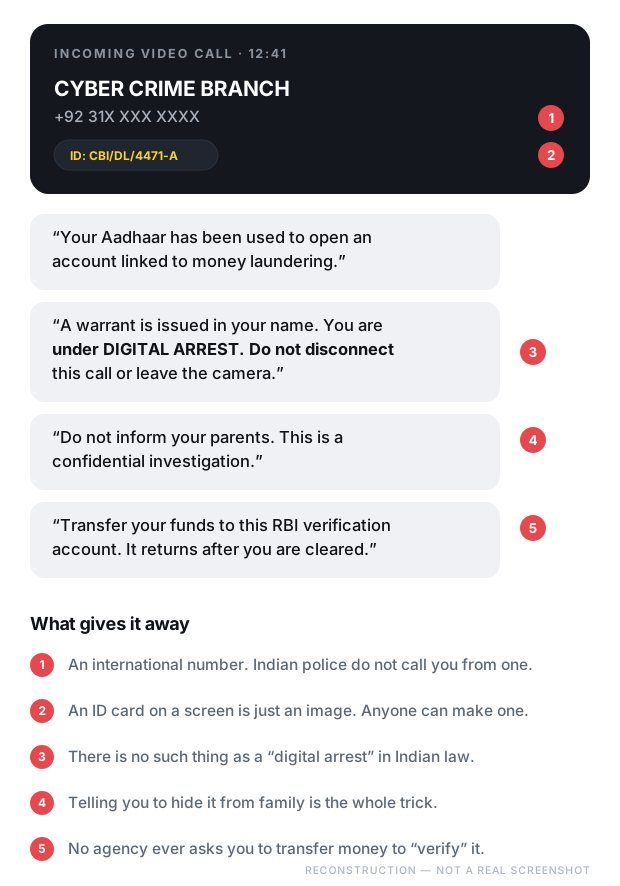
These calls are staged carefully — uniforms, a room dressed to look like a police station, a fabricated warrant with your real Aadhaar number on it. The production quality is the point. The law underneath it is fiction.
The one-line version
There is no such thing as a digital arrest in Indian law. No agency arrests anyone, or collects any money, over a video call.
Step by step
How it actually works
This scam runs for hours rather than minutes, and it is built to keep you isolated for every one of them.
01
An automated call opens it
Usually a recorded message: a parcel in your name was seized with drugs, or your Aadhaar or SIM has been used in a crime. You are asked to press a number to speak to an officer.
02
You are passed “up the chain”
A more senior-sounding officer joins, often switching to video. Uniform, badge, a backdrop that looks official. The seniority is theatre designed to make you comply rather than question.
03
Documents arrive
A warrant, an FIR, or a notice with your name and Aadhaar number is sent over WhatsApp. Getting your details right feels like proof. It only means the data leaked, which almost everyone’s has.
04
You are isolated
Stay on camera. Do not disconnect. Do not tell your parents — it would obstruct a confidential investigation. Some people are kept on a call for six or eight hours. This step is the scam; everything else is decoration.
05
The transfer is demanded
Move your money to a “verification account” or “RBI escrow” so it can be cleared and returned. It is never returned, and no such account exists.
Red flags
If you see any of these, stop
You don’t need all of them. One is enough to walk away.
Any video call claiming to be the police. Indian police do not investigate, interrogate or arrest over video calls.
Being told not to tell your family. This is the tell. No real investigation requires you to hide it from your parents.
Any request to transfer money for verification, clearance, bail, or to prove the funds are clean.
An international number, or an ordinary mobile number. A caller ID can be faked, so a plausible number proves nothing either.
Threats of immediate arrest unless you act in the next few minutes.
Being told to stay on camera or to move to a room alone.
If it is happening right now
What to do while the call is live
If you are reading this with a call still running, start at the top.
Disconnect the call. You are allowed to. Nothing legal happens because you hung up.
Walk into another room and tell one person — a parent, a friend, a warden, anyone.
Do not transfer money, and do not share your bank details, OTP or Aadhaar number.
Block the number. Expect them to call back from a different one, and let it ring.
Screenshot the call log and save any documents they sent. Do not delete the chat.
If you have already transferred anything, call your bank and 1930 straight away.
If it already happened
You transferred money. What now?
People who fall for this are not gullible. They are people who were frightened, cut off from anyone who could have said “this is fake”, and kept that way deliberately for hours. That is a designed outcome, not a personal failing.
Do this first
Call your bank immediately and report every transfer, then call 1930. Save the call logs, the numbers, the fake documents and any account details you were given — all of it is evidence. File at cybercrime.gov.in and tell your family today, not later.
Want to check with real police yourself?
Call 112 — India’s general police emergency number — and describe what happened. Do this on your own initiative, never using a number given to you during the call. A real officer will not mind you checking; that instinct is exactly what the scam is designed to shut down.
Keep going
Related scams
OTP & KYC phishing
A lookalike bank link, then a call asking for your OTP.
Sextortion & video-call blackmail
A quick video call, then a threat to send it to your contacts.
UPI collect request fraud
A “refund” that quietly sends your money the other way.