What it looks like
Built to be found at the wrong moment
These sites appear around result season and admission deadlines, promoted through ads and WhatsApp forwards. They are designed for the exact week when a student is searching quickly and not reading carefully.
The one-line version
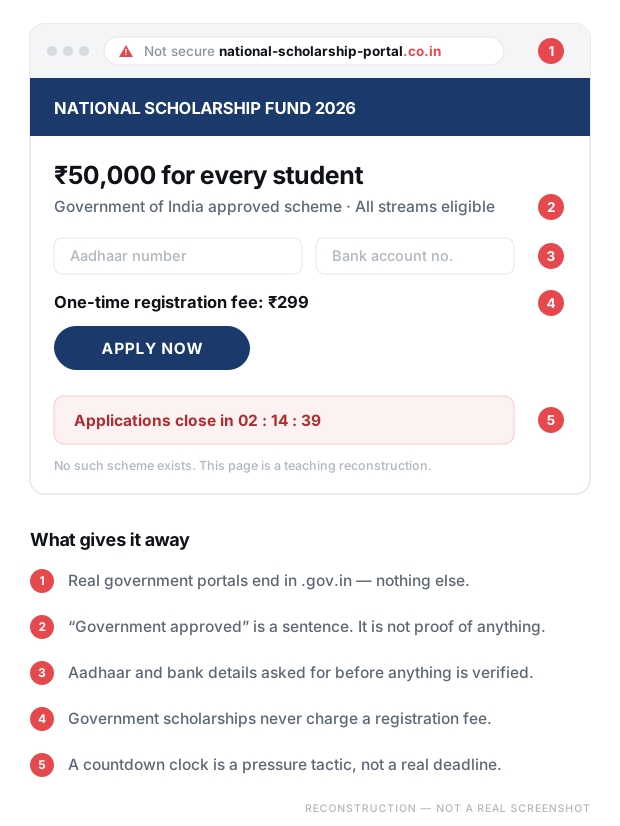
Government portals end in .gov.in, and government scholarships never charge a fee to apply.
Step by step
How it actually works
The money is the smaller half of this one. The data is worth considerably more.
01
Timing
The site goes live around board results, university admissions or scholarship deadlines, when search volume spikes and everyone is in a hurry.
02
The lookalike address
A domain that reads correctly at speed — the real scheme’s name with an extra word, or the right name on a .co.in or .org.in instead of .gov.in.
03
The data harvest
Aadhaar number, date of birth, bank account and IFSC, sometimes a photo of your Aadhaar card. Together this is enough to attempt identity fraud in your name — loans, SIM cards, mule accounts.
04
The fee
A small processing or registration charge, usually a few hundred rupees. Low enough that most people pay without pausing, and profitable at volume.
05
Sometimes, an app
Some sites push an APK file to “track your application”. Installing it can hand over your SMS messages, which is how OTPs start leaving your phone without you seeing them.
Red flags
If you see any of these, stop
You don’t need all of them. One is enough to walk away.
Any address that is not .gov.in claiming to be a government scheme. Not .co.in, not .org.in, not .gov.co.in.
A registration or processing fee. Government scholarships in India do not charge students to apply.
“Every student is eligible.” Real schemes have income limits, marks criteria and category rules.
Aadhaar and bank details requested before anything is verified, on a page with no padlock.
A countdown clock. Real deadlines are published dates, not ticking timers.
A download link for an app outside the Play Store or App Store.
Check first
How to verify a scholarship in two minutes
Before you type a single digit of your Aadhaar number.
Type the official portal address into your browser yourself. Never arrive from a forwarded link or an ad.
For central government schemes, the National Scholarship Portal is at scholarships.gov.in. Check the address bar says exactly that.
For state schemes, find the state government’s official portal through the state education department site — not through search ads.
Ask your college scholarship or student welfare office. They deal with this every year and will know the scheme.
Check the eligibility criteria. A real scheme states income limits, categories and required documents clearly.
If a fee is mentioned anywhere, close the tab. That alone settles it.
If it already happened
You already entered your details
If you only paid a fee, treat it as money gone and report it. If you handed over your Aadhaar number and bank details, the more important work is limiting what can be done with them.
Do this first
If you paid, call your bank and 1930, then file at cybercrime.gov.in. If you shared Aadhaar or bank details, lock your Aadhaar biometrics through the UIDAI website or mAadhaar app, watch your bank statements closely for the next few months, and check whether any loan or account has been opened in your name. If you installed an app they sent, uninstall it, and change the passwords for anything that uses SMS-based verification from a different device.
Keep going
Related scams
OTP & KYC phishing
A lookalike bank link, then a call asking for your OTP.
Fake job & internship offers
Selected for a job you never applied to, then asked for a fee.
UPI collect request fraud
A “refund” that quietly sends your money the other way.