A digital arrest scam is a fake call from someone pretending to be police, CBI, customs, or other such government agency. They say you are “under arrest” on video and must pay money to be freed. It is not real. Indian law has no “digital arrest”, and no officer can arrest you over WhatsApp or other such platforms,
Scammers rely on one thing: you panic before you think. And it works at a huge scale. In November 2025, the Supreme Court said around ₹3,000 crore had reportedly been taken from victims across India.
This article covers what the scam means, how to check a call in 30 seconds, and what to do if money has already left your account. If you were tricked, it is not your fault. These are organised gangs, and they are good at scaring people.
Key Takeaways
- A digital arrest is a made-up threat. No police office, CBI agent, or judge can arrest you on a video call.
- Real officers never ask you to stay on camera, keep secrets from your family, or pay money to prove you are innocent.
- If a call scares you, hang up, and talk to your parents, friend, or teacher before taking action.
- If you already paid, call 1930 immediately, because a quick report gives the best chance of freezing the money.
- Never share your bank account information for “easy commission”, because students have been arrested for it.
What is a Digital Arrest Scam?
Digital Arrest Scam meaning in simple words
“Digital Arrest” is a name scammers made up. The caller says you are linked to a crime, like drug smuggling, money laundering, or a SIM card used for fraud. Then they say you are “under arrest” and must stay on a video call until you pay. Many people also call it a fake police video call scam.
Scammers pretend to be the police, CBI, customs, ED, RBI, TRAI, or other such government agencies. Even the phone numbers can be faked, a trick called spoofing. That is why a CBI fake call scam can look and sound like the real thing.
The 4 steps of a “Digital Arrest” call
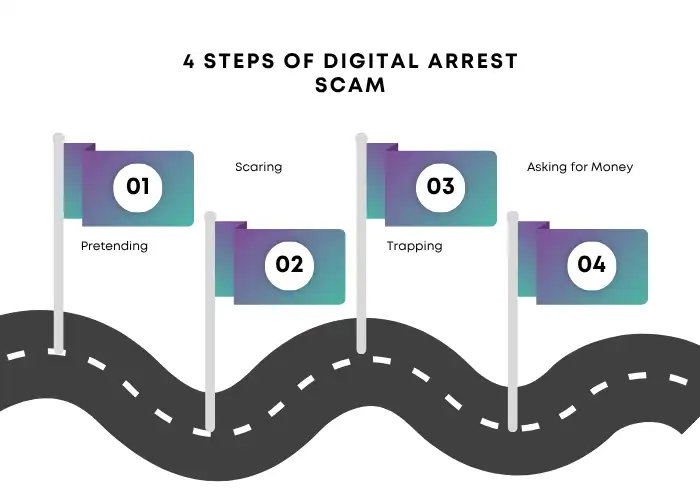
The Indian Cyber Crime Coordination Centre (I4C), which comes under the Ministry of Home Affairs, states the digital arrest scam is carried out in the following four steps:
- Pretending: The caller acts like an officer, often with a fake ID, a uniform, or a set built to look like a police station.
- Scaring: They accuse you of a serious crime and threaten jail.
- Trapping: They tell you to stay on camera and not tell anyone.
- Asking for money: They demand a transfer for “verification” or “bail”.
Want to see the exact messages and warning signs? Read our Digital Arrest Scam Guide.
Why “Digital Arrest: is not real in Indian law?
I4C says there is no concept of digital arrest under any Indian law. It has also said that the CBI, police, customs, ED, and judges do not have the power to arrest anyone on video calls. India’s arrest law, the Bhartiya Nagrik Suraksha Sanhita (BNSS), 2023, has no arrest by video call.
What the scammers do is a crime. Anyone running a digital arrest scam can be charged for cheating, extortion, and pretending to be a government official. This is general information, not legal advice. For your own case, always speak to a lawyer or local police before taking any decision.
Why Fake Police and CBI Calls Work on Students
Fear, a uniform and a deadline
This scam works on fear. A serious voice, a uniform, a police-station background, and a ticking clock would rattle anyone. Some gangs now use fake FIRs, forged court orders and even AI-made videos.
In October 2025, India’s apex court started its own case after an elderly couple in Ambala said they were shown forged orders that looked like they came from the court.
The stories students hear
A digital arrest scam call usually starts with a hook like one of the following:
- A parcel in your name was caught with drugs or fake passports.
- Your SIM card or phone number will be blocked.
- Your Aadhaar was used for money laundering.
Here is a real case. In July 204, an IIT Bombay student got a call from someone claiming to be from TRAI. A man in a police uniform then appeared on WhatsApp video and pushed him to send ₹29,500 by UPI. The gang later got his bank details, and he lost over ₹7 lakh in all.
He learned it was a fake call only after searching online. Searching early, before making any payment, is a habit worth copying.
When the target is your parents
Rohtak police has warned about callers who say your son or daughter is in custody and money is needed to save them. Tell your parents now, and agree on one rule: if a call says someone in the family is in trouble, phone that family member directly and verify.
🎯 Pro Tip: Set a family code word, and if a call says a relative is in trouble, ask for the word before doing anything.
How to Check if a Police or CBI Call is Fake
What real police and the CBI never do
If a real police officer or CBI agent will call you, they will never do any of the following:
- Arrest you over a video call
- Ask you to stay on camera for a long time
- Tell you to hide this call from your parents, friends, or family
- Ask you to pay
- Ask your OTP, UPI pin or net banking password
Payment red flags
Any payment “to prove your innocence”, “for bail”, or “for safekeeping” is a scam. Watch for a UPI collect request too that will come as a message in GPay, PhonePe, or Paytm asking you to approve a payment. If you approve it by entering your UPI pin, the scammer will be able to take money out of your account. They may call it “verification” or a “refund”, but to receieve money, you do not have to enter your PIN.
What to do during the call
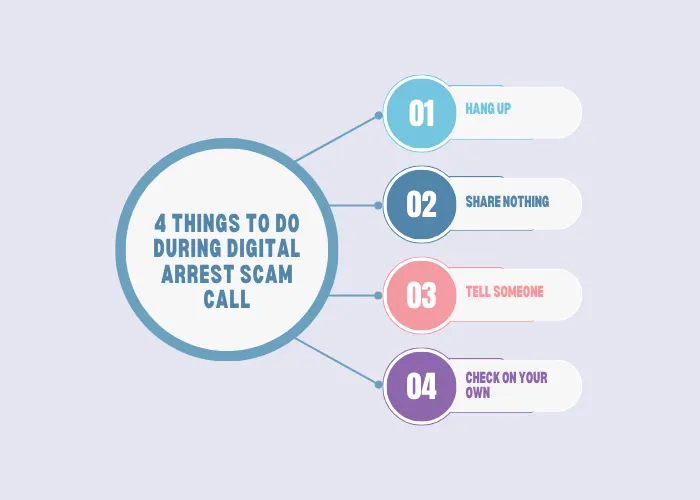
You can perform the following actions during a digital arrest scam call:
- Hang up: You are allowed to cut the call at any point and this is the best step you can take during such calls.
- Share nothing: Do not share sensitive details such as your Aadhaar number, OTP, UPI pin, banking details, address, etc. during a digital arrest call.
- Tell someone: Cut the digital arrest scam call and immediately call your parents, friends, or teacher. Secrecy is part of the trick.
- Check on your own: Find your local police station’s number and call it yourself and share all the details with them. But never use the number that the caller gave you.
💡 Pro Tip: After you hang up, screenshot the caller’s number, name, and any ID or documents they showed, because you will need them for your complaint.
Already Sent Money? Do This Within the First Hour
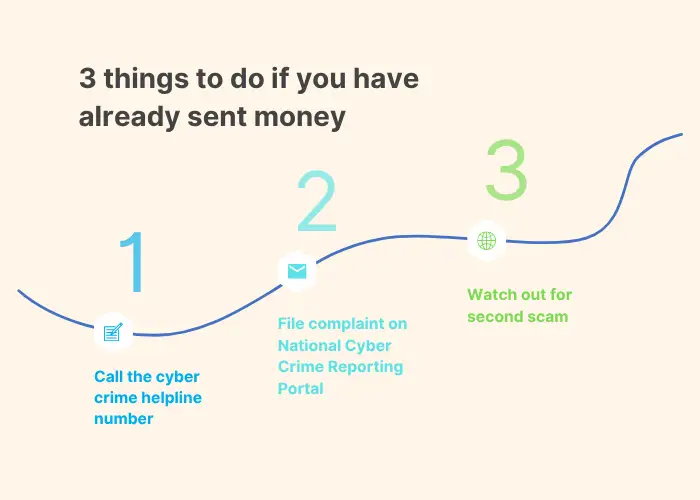
If you lost money to a digital arrest scam call, speed matters the most. Money you send yourself is harder to recover then money taken without your knowledge. So the first hour is crucial.
Call the cyber crime helpline number
Dial 1930, India’s national cyber crime helpline. Tell the operator how much you send, and to which account. The team will then alert the bank in which you have account, and ask them to freeze the money. Call your own bank branch as well and share the same details with them.
This can work. In May 2024, a man from Mumbai sent ₹40 lakh to a fake officer, then immediately called 1930. Police contacted the bank and the money was frozen.
File a complaint on the National Cyber Crime Reporting Portal
Go to cybercrime.gov.in, the National Cyber Crime Reporting Portal run by I4C. Choose financial fraud, add relevant details, and upload your proof. Save the acknowledgement number to track the complaint.
You can report the cyber crime even if you lost no money. Your report helps police connect cases. Keep screenshots, phone numbers, UPI transaction IDs and any fake documents they sent.
Watch out for the second scam
After a loss, strangers on Telegram and other such platforms will reach out to you and offer to get your money back for a fee. Some might even ask you to pay in crypto. Beware, this a crypto recovery scam.
Real recovery goes through the police and your bank, and nobody legitimate asks for money upfront.
Recovering the money is possible, but not guaranteed. According to Verdictum, As of August 2026, the government’s money restoration system has returned close to ₹20 crore to victims across 37,000 cases.
Has this happened to you? Reporting takes less than five minutes and helps others too.
What Has Changed in 2026?
Fewer complaints, but still serious
Digital arrest scam complaints on India’s National Cyber Crime Reporting Portal fell from 1,23,672 to just 58,239 in 2025. According to Verdictum, from January to June 2026, they were nearly 16,000.
The court called the trend encouraging but said continued monitoring is essential.
Supreme court and CBI action
The Supreme Court has ordered a pan-India CBI probe into these cases. In August 2026, it also told the RBI to issue, within four weeks, a standard process for banks to place temproary debit holds on accounts linked to mule activity.
A mule account is a bank account used to receive and pass on stolen money.
The same networks run other scams
Many of the gangs also run investment scams, such as the Telegram investment scam, where strangers push you to invest and show fake profits. Investigators say many of the digital arrest scam calls come from scam compounds in Southeast Asia.
🔔 Pro Tip: Save 1930 in your phone contacts today so you are not searching for it while you are panicking.
Do Not Share Your Bank Account Information
Students are not only the targets of these digital arrest scams, but some get pulled in on the other side.
In December 2024, police in Indore arrested four college students after a fraud gang used one student’s bank account to receive digital arrest money. About ₹15 lakh came in and ₹10 lakh was taken out. The students had shared the account for a commission.
Offers like “earn ₹5,000 for letting us use your account” are the same trick. The account is in your name, so police can trace the money back to you.
Say NO even if a friend brings this offer.
Two-Minute Habits That Keep You Safe from Digital Arrest Scam
The following habits can keep you protected from digital arrest scams:
- Pause before paying: Do not share money or ID details on any of the calls that scares you.
- Tell one trusted person: Scammers want you alone. Always talk to your parents, friends or teachers about such call, as even one extra voice can break the spell.
- Check it yourself: Search the story online with the word “scam”, like “SIM blocked call scam”. Then call police or other agencies on their official numbers.
Talk about these things often. Regular chats on online fraud awareness in your class, hostel, or family group can make you harder to fool.
Want the full picture on staying safe online? Read our complete guide.
The Bottom Line: Hang Up, Check and Report
No one can arrest you over a video call. If a call scares you, hang up, tell someone you trust, and check the story on your own. If you have already paid, call 1930, and file a complaint on cybercrime.gov.in.
Falling for a digital arrest scam does not make you careless. It means the scammers did their job well.
FAQs: Digital Arrest Scam
Q1. What is a digital arrest scam?
A digital arrest scam is a fear trick, not a legal process. A caller pretends to be from police, CBI, or customs and says you are “under arrest” on video. They tell you to stay on camera and then ask you for money to “clear” your name.
Q2. Is digital arrest legal in India? Can police arrest you on a video call?
No. I4C says there is no concept of digital arrest under any Indian law. Arrests follow the process in the BNSS, 2023, which does not include arrest video call. This is general information, and not a legal advice.
Q3. How can I tell if a CBI or police call is fake?
Watch for talk of “digital arrest scam”, orders to stay on video and keep it secret, and demand for money, OTP, or bank details. A number that looks official can still be fake because of spoofing. Hang up and call your local police station immediately.
Q4. What should I do if I get a fake police video call?
End the call and share nothing. Tell your parents, friends, or teachers. Remember to take screenshots of the number and any documents shown. Then report it at 1930 or cybercrime.gov.in, even if you didn’t lose any money.
Q5. Can I get my money back after a digital arrest scam?
Sometimes. Calling 1930 quickly gives the best chance of freezing the money, as in the Mumbai case above. Recovery is not guaranteed and can take time. Be careful of anyone who offers to recover your money for your recovery for a fee, because that is a second scam. Reporting a digital arrest scam early helps the police act faster.