Online fraud awareness is not about knowing the name of every new scam. Rather, it is about recognising the warning signs that keep appearing across different scams such as fear or urgency, unexpected payments, suspicious links, OTP requests, and pressure to act before you have time to think.
Scammers keep changing their stories, but the tactics behind those stories often surprisingly remain similar.
For example, a fake bank message may create an urgency by informing you that KYC is expiring. Or a WhatsApp message promising an easy part-time job. Or the scammer may call you impersonating police, your bank, or a courier company asking your personal and sensitive information.
But, with better online fraud awareness, you can learn to recognise the behaviour shown by online scammers that can help you stop and verify before making any hasty decision.
Key Takeaways
- Online fraud awareness starts with recognising pressure, urgency, and unusual requests before you act.
- Always verify suspicious calls, messages, payments, or links through an independent and trusted source.
- Never share OTPs, passwords, UPI PINs, or other sensitive details with an unexpected or suspicious individual.
- Protect your email, WhatsApp, banking, and social accounts with strong passwords and two-factor authentication.
- If fraud happens, act quickly by contacting your bank, calling 1930, and reporting it at cybercrime.gov.in.
The Digital Big Brother’s 6 Tips to Stay Safe Online
Everything today is connected to the internet, and as a result it has become a lot easier for fraudsters to run scams. It has a become all the more important to take different safety measures to help protect yourself online.
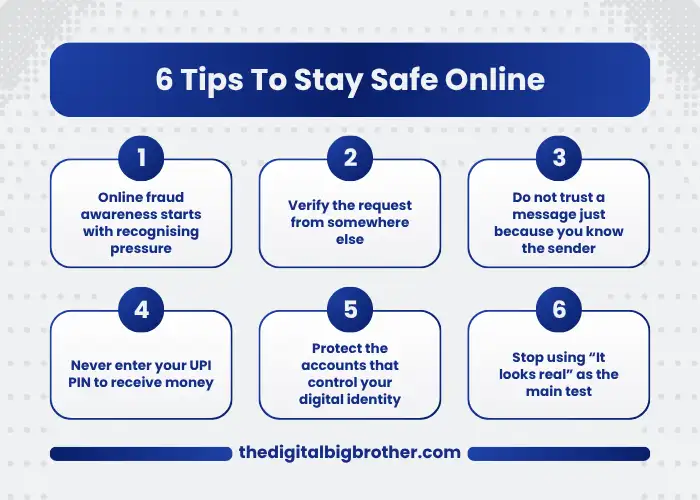
Here are 6 tips from The Digital Big Brother that will help save yourself from potential scams:
- Online fraud awareness starts with recognising pressure
- Verify the request from somewhere else
- Do not trust a message just because you know the sender
- Never enter your UPI PIN to receive money
- Protect the accounts that control your digital identity
- Stop using “It looks real” as the main test
Now, let’s look at then in detail.
1. Online Fraud Awareness Starts With Recognising Pressure
Pressure is one of the biggest warning signals of online fraud.
A typical scammer works by not giving you enough time to independently check & verify what they are saying. They may tell you that your bank account will be frozen, or your SIM will stop working, or a parcel in your name has been intercepted because it contains illegal items.
The story changes from victim to victim, but the tactics and pressure remains the same.
Therefore, the key to online fraud awareness is to slow down when someone (read scammer) is pushing you to act immediately.
Be especially careful if someone:
- threatens account suspension, arrest (digital arrest) or penalties
- asks you to send money immediately
- wants your OTP, password, card PIN or UPI PIN
- asks you to install unknown app(s)
- sends you an APK file through WhatsApp or Telegram
- promises investment opportunities with unusually high ROIs
- offers easy money for completing simple online tasks
- tells you not to discuss the situation with anyone
Good scam awareness is not about assuming that every message is fraudulent, but it is about recognising a message that deserves a second check or verification.
2. Verify the Request from Somewhere Else
Independent verification is one of the best practices you can follow for online fraud awareness.
Let’s assume, someone calls you claiming that they are from your bank and says your account has a problem. To resolve this issue, they ask for OTP that they have sent on your mobile number.
In such a scenario, you should immediately end the call and either open your bank app or go to your branch and contact customer support.
The same rule works pretty much works in all kinds of such situations.
Let’s take another situation.
If you recieve a WhatsApp message from your friend’s number or an unknown number claiming to be your friend and asks you for ₹20,000 urgently.
Now, in this type of situation, your first response will be to send the requested amount, after all it is your friend who is asking for money. Right?
Wrong! Instead of straight away transferring the money, call your friend on the number that is actually saved in your mobile and ask if they really do need the money.
If they decline, then obviously it was a scam message and you should report this cyber crime on the official government portal yourself.
Every time you get such calls or messages, your immediate response should not only be:
“Does this message look genuine?”
You should also ask:
“Can I confirm this without using anything the sender has given me?”
This small change in behaviour can make online fraud awareness far more practical.
3. Do Not Trust a Message Just Because You Know the Sender
Cyber scams are commonly associated with unknown phone numbers and strange email addresses.
But this knowledge or awareness is not sufficient now.
You can receive a suspicious message from a number or email of someone you know.
Scammers can use a compromised WhatsApp, email, or social media account to contact’s your friends, colleagues, or family members.
That means, even though the profile photo or name may be genuine but the request will not be.
📝 Important Note: If someone you know suddenly sends an unusual link, attachment, or requests money, then it is best to practice it separately.
This type of online fraud awareness is especially important on platforms like WhatsApp, where trusting a message from an account of a known person is easy.
4. Never Enter Your UPI PIN to Receive Money
In the age of UPI and digital payments, this is like a golden rule.
Online payment apps like GPay, PhonePe, Paytm, and BHIM have made making payments online so simple. However, scammers use this convenience and ease to scam people.
📝 Remember One rule: You do not need to enter your UPI PIN to receive money.
Use your UPI PIN only when you have to make a payment.
If someone asks you to enter your UPI PIN because they are sending refund, reward, cashback, or payment, stop and check what is actually happening on your screen.
Also be careful with QR codes.
Scanning a QR code should not become an automatic reaction just because someone tells you it is necessary to receive money.
Understanding what you are authorising is the key to effective online fraud awareness.
5. Protect the Accounts That Control Your Digital Identity
Online fraud doesn’t always mean losing money.
Your email, WhatsApp, and social media accounts can also provide access to a much bigger part of your digital life.
For example, if a scammer gains control of your email, they can reset passwords for your other accounts.
If your WhatsApp account gets compromised, scammer can impersonate you to scam your friends and family.
🔔 Important Note: Basic account security is therefore an integral part of online fraud awareness.
The following are some tips that can help you secure your primary accounts:
- Use different passwords for important accounts
- Enable two-factor authentication where possible
- Keep your phone, browser, and apps updated
- Regularly check which devices have logged into your important and primary accounts
- Never share an OTP simply because the scammer knows your personal information (A caller knowing your name, bank, workplace, or address does not prove that they are genuine).
6. Stop Using “It Looks Real” as the Main Test
Gone are the days when you could spot a scammer from their badly written language with easy to spot spelling mistakes.
Nowadays, scammers use polished language, some even use AI to draft professional emails or messages. A convincing logo, professional website, WhatsApp profile picture, official looking documents, etc. are common practices among modern scammers.
They have become highly sophisticated, with some using AI and other softwares to generate familiar voice and videos to scam people.
As a result, you should not get convinced by an email, message, video, or voice call that it is from someone you know. A scammer can be using any of the several tools and softwares to fool you.
Instead, you must focus on the request.
Is someone asking you to transfer money?
- Share an OTP?
- Install an app?
- Open an unexpected attachment?
- Provide banking details?
- Move the conversation away from the official platform?
Any of these actions are a red flag and you should take preventive actions as soon as you spot them.
Use this 60-Second Online Fraud Awareness Check
To protect yourself from getting scammed, you do not need complicated cybersecurity knowledge.
You just have to give yourself a minute before sending money, sharing information, installing an app or opening unexpected links.
Following are the things you must do in this 1-minute:
- Who started this conversation? – Was this from someone I was expecting from?
- What are they asking me to do? – Are they asking for money, an OPT, PIN, password, app installation, or opening a suspicious looking link?
- Why does this need to happen immediately? – Is this urgency genuine or is someone trying to stop me from thinking?
- Can I verify this independently? – Can I contact the bank, company, friend, or organisation myself?
- What will happen if I wait five minutes? – A genuine organisation or a friend or family member will give you the time to verify your request.
This simple checking can provide you with knowledge necessary for online fraud awareness.
You do not have to prove that something is a scam. But, you have to give yourself enough time to check & verify before taking an action that could become difficult to reverse in the future.
Online Fraud Awareness Also Means Knowing What to Do After Fraud
Even with strong knowledge of online frauds, there is no guarantee that you will never fall for a scam.
Fraudsters deliberately use fear, trust, authority, financial pressure, and urgency to scam you.
If you have already transferred the money and have become a victim to the scam, what you do next will determine what will happen with the money and yourself.
For any financial fraud in India, quickly call the National Cybercrime Helpline at 1930 and report the crime at cybercrime.gov.in.
You should also contact your bank, card issuer, UPI provider or wallet using their official support channels.
Save anything connected to the fraud, including:
- screenshots
- transaction IDs
- UTR numbers
- phone numbers
- WhatsApp conversations
- email addresses
- UPI IDs
- website links
- social media user names
Do not delete the conversations and other details just because you feel embarrassed about what happened.
The evidence you provide the police and authorities, then it can help them recover & return you money.
Most importantly, do not waste even a second arguing with the scammer or trying to convince then to return you money.
Instead, you should start reporting.
Conclusion: Staying One Step Ahead Starts With a Pause
The goal of online fraud awareness is not to predict every scam that will happen next week or next year.
New stories will keep appearing.
You cannot control them, but instead you can control how quickly you react to them.
Pause when someone creates urgency. Verify requests independently. Never share OTP or PIN because the caller sounds convincing. Read payment screens before putting your UPI PIN. Be careful with unexpected links, apps, and attachments.
But, if you have already become the victim to online financial scan, act quickly by contacting your bank, calling 1930, and filing a complaint through cyvercrime.gov.in.
Scammers depend on getting you to act before you can check and verify.
FAQs: Online Fraud Awareness
Q1. How can I protect myself from online fraud?
Use strong passwords, enable two-factor authentication, verify unexpected requests independently and never share OTPs, PINs, or passwords with callers or message senders.
Q2. What should I do immediately after online fraud?
For financial cyber fraud in India, contact your bank or payment provider, call 1930, save the evidence and report the incident at cybercrime.gov.in.
Q3. How can I identify an online scam?
Common warning signs include unexpected urgency, requests for sensitive information, pressure to transfer money, suspicious links and promises that appear unusually profitable or easy.
Q4. Can someone steal money if I share my UPI ID?
A UPI ID alone does not authorise a payment from your account. But be careful if someone asks you to approve a collect request, scan a QR code, or enter your UPI PIN.
Q5. What information should I never share online?
Never share your OTP, banking passwords, card PIN, UPI PIN, or other authentication details with someone who contacts you asking for them.
About the author
Rishabh Dev Choudhary writes and edits The Digital Big Brother. He isn’t a security engineer and doesn’t pretend to be — his work is reading government advisories, police notices, and reader reports, then rewriting them in language a nineteen-year-old will actually finish. Every scam example on this site is a reconstruction built from reported cases, and is labelled as one. More about the author →