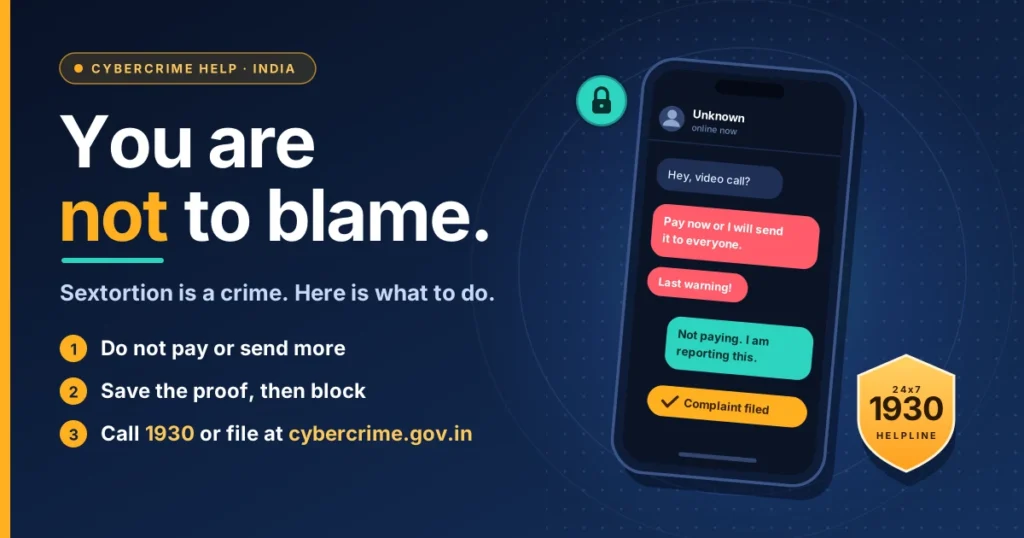
Sextortion is a type of blackmail that uses intimate photos, videos, or a recorded video call as the threat. The blackmailer says they will send it to your family, friends, or college unless you pay money or send more content.
If this is happening to you, stop replying immediately, do not pay, save screenshots of everything, and report it at cybercrime.gov.in or call 1930. These are the same steps the cybercrime cell advises.
Students are easy to reach on Instagram and WhatsApp, and the fear of parents or the college finding out can feel overwhelming. This fear is exactly what scammers count on.
This guide explains what sextortion is, how it reaches students in India, what to do in the first hour, how to report it, which Indian laws apply, and where to get support.
Key Takeaways
- Sextortion is blackmail using intimate images or videos, and the blame lies with the blackmailer, never with you.
- Do not pay or send more content, and save screenshots and payment details before you block.
- Report to the national cyber crime reporting portal and 1930, especially quickly if you have already sent money.
- Real police never demand money over a call or WhatsApp, so a “police officer” asking for payment is part of the scam.
- Tell one trusted person today, because you do not have to handle this alone.
What is Sextortion?
Before you learn how to report sextortion, it helps to know exactly what you are dealing with.
Sextortion combines “sex” and “extortion”. Someone gets hold of, creates, or claims to have an intimate image or video of you, and uses it to force you to pay money or send more such content.
The material can be real, edited, or even AI-generated. Often, the blackmailer only claims to have it and shows a clip of someone else to frighten you.
📌 Remember: The threat only works while you are alone with it. Once a trusted person or the police know, most of this power is gone.
So sextortion is a crime, and the person committing it is the one committing it, not you.
How Sextortion Reaches Students in India
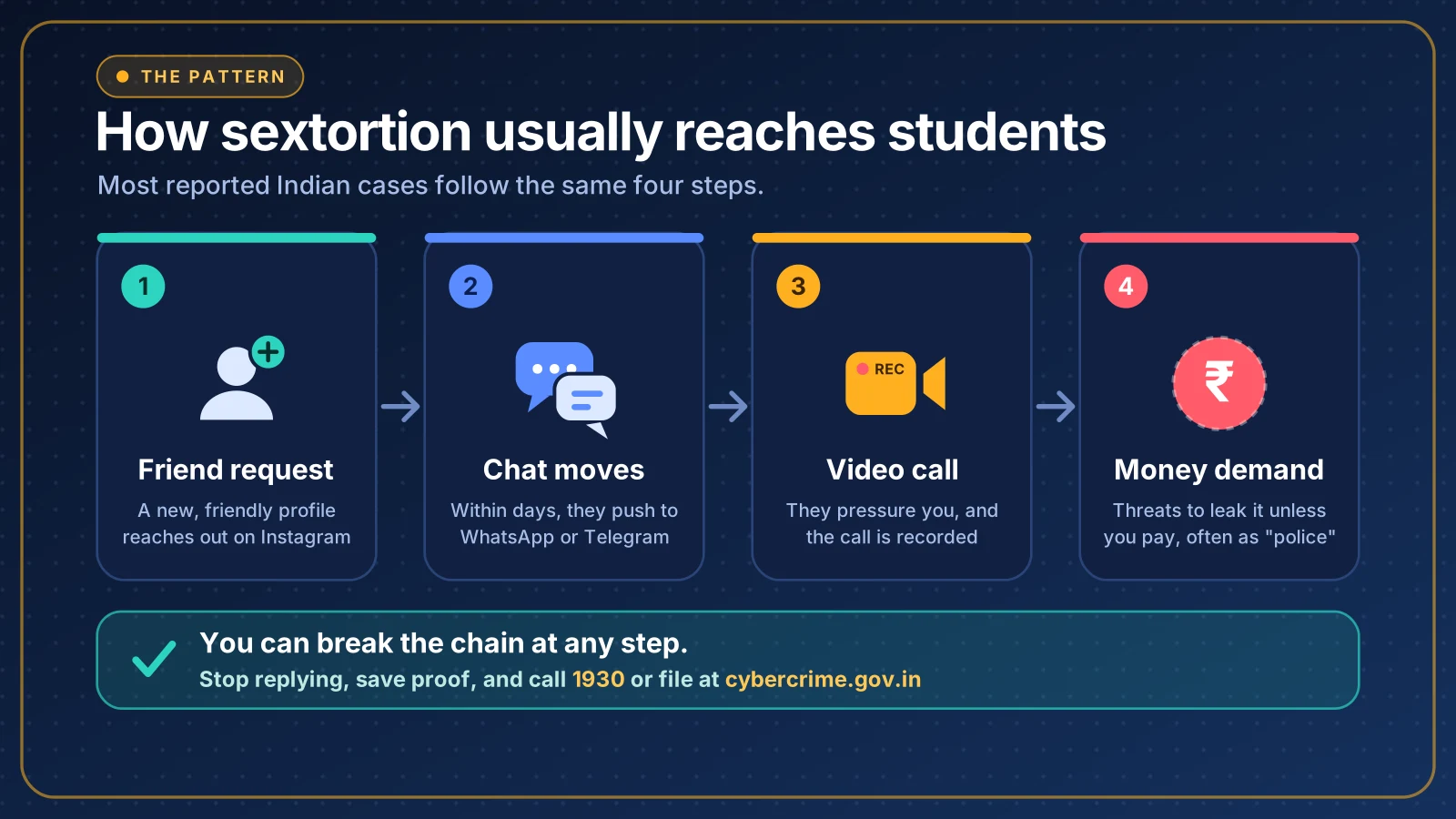
Reported sextortion cases follow a familiar pattern, and knowing it makes the threat easier to spot.
It usually starts with an Instagram request, moves to WhatsApp, then to a recorded video call, and ends with a demand for money. In a case reported by The Free Press Journal in October 2025, an 18-year-old college student in Palghar accepted an Instagram request, chatted on WhatsApp, and was pressured into undressing on a video call that the man recorded. The next day, he called the victim again, posed as a police officer, and threatened to make the video viral unless they paid ₹18,000. The police later arrested two men.
⚠️ Heads Up: Real police do not demand money over a call or WhatsApp message to “settle” a case. A “police officer” asking for payment is part of the scam.
Students are not careless. They are online a lot, often living away from home, and very worried about what parents, hostel mates, and teachers will think. Blackmailers use that worry and ask for amounts a student might manage from an allowance. Then the demand repeats.
🔒 Safety Habits: Keep your camera off on video calls from unknown people until you fully trust them.
In the end, the pattern is the same across cases, and spotting it early is your best protection. For a step-by-step reconstruction of one version, see our Scam page on video call blackmail.
6 Warning Signs that a Chat is Heading Towards Sextortion
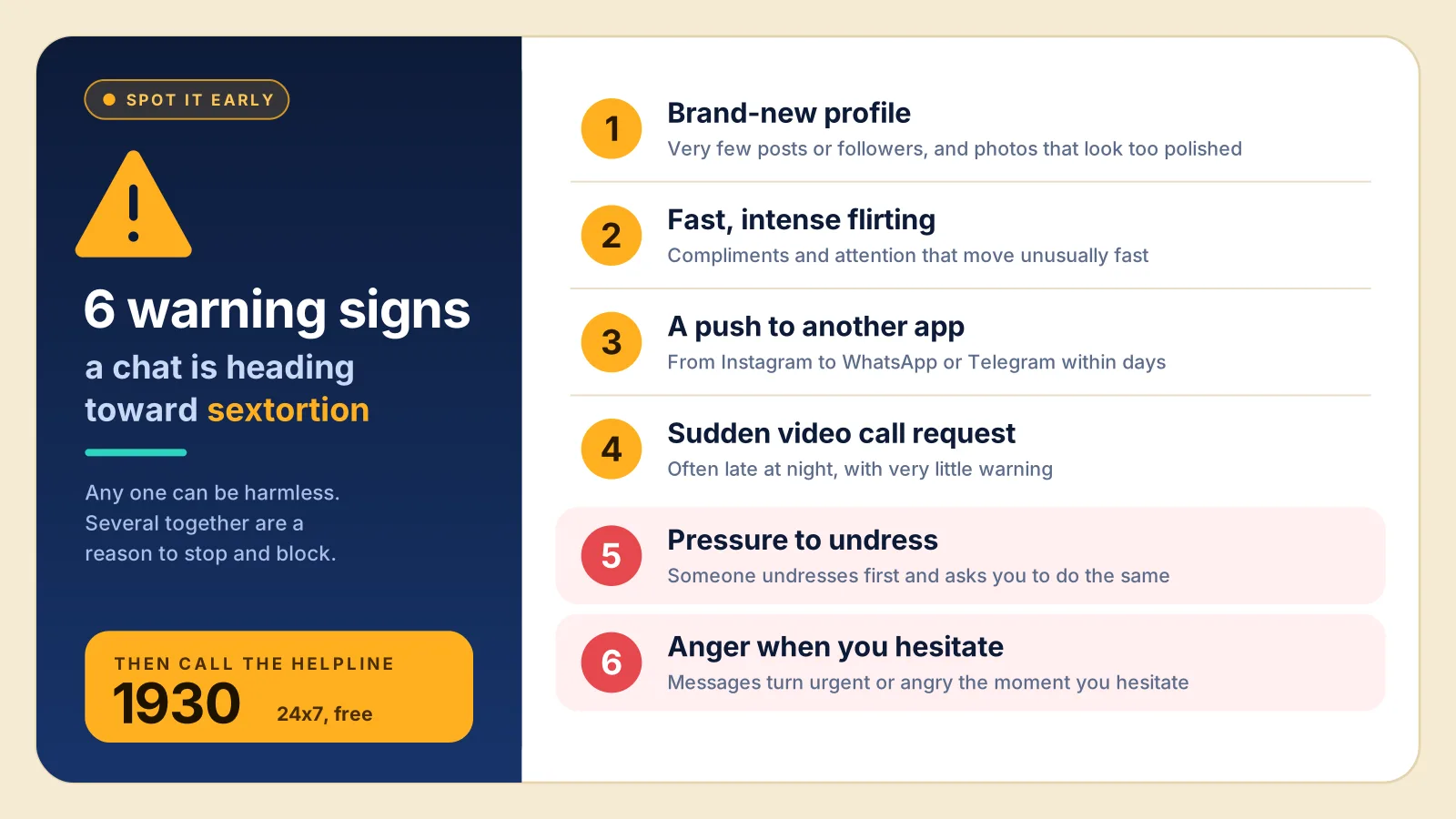
Most sextortion scams follow a script. So reading only a few signs can tell you early if something is off. Spotting such signs does not mean you failed to maintain your privacy. It just helps you stop sextortion scams sooner.
Let’s look at the 6 common signs that can tell you that you might be getting affected by a sextortion scam:
- A new profile with very few posts or followers, or photos that look too polished.
- Flirting or compliments that feel unusually fast and intense.
- A push to move from Instagram to WhatsApp or Telegram within a short time.
- A sudden request for a video call, often late at night.
- Pressure to undress or someone who undresses first and asks you to do the same.
- Messages that turn urgent or angry the moment you hesitate.
Any one of these signs, individually, can look harmless, but several of them together are a good reason to stop replying and block the account. You never owe a stranger an explanation for ending the chat.
Has this happened to you? Reporting takes less than five minutes and helps others too.
How Common is Sextortion in India?
Ministry of Home Affairs data reported by ThePrint shows 28.15 lakh cybercrime cases were reported in 2025, up from 22.68 lakh in 2024. The same data shows that sextortion cases made up 19% of all cases, roughly one in five, but only 4% of the money lost.
The low share of money lost makes sense. Sextortion demands are often smaller than in investment scams, but they reach a very large number of people.
If this is happening to you, you are far from alone, and the systems that handle it were built with cases like yours in mind. Sextortion is also one part of a wider problem, which is why online fraud awareness matters for every student, not only for the people who have been targeted.
Myths About Sextortion that Keep People Silent
Shame survives on myths. Clearing a few of them makes it easier to ask for help.
The following are myths that keep victims of sextortion silent:
- If I pay once, it will end: Demands tend to grow once you fall for it. In the Palghar case above, the calls kept coming from different numbers even after part of the money was paid.
- The police will blame me: A complaint is about what the blackmailer did. Sharing a private video or photo with someone you trusted is not a crime; blackmailing someone with it is.
- They definitely have my real video: Sometimes the blackmailers do have a recording, and sometimes they only claim to. Either way, the right response is the same: do not pay, save evidence, and report.
- Deleting my account will make it go away. Deleting your account can wipe out the evidence, and it does not stop the blackmailer. Save everything first.
These are only some of the common myths surrounding cases of sextortion.
Want the full picture on staying safe online? Read our complete guide.
What to do Right Now If You Are Being Blackmailed?
If you are being targeted right now, there are 5 steps you can take to save yourself:
- Stop replying
- Save the evidence
- Report
- Call 1930
- Report the account on the app.
Let’s understand them in detail below.
1. Stop replying and do not pay
This is the first step and also the hardest because panic pushes you to give in.
Paying rarely ends it; rather, it tells the blackmailer that you will pay, and the demand tends to grow. Do not send more photos or videos or pay even if they promise to delete everything.
Stopping here protects both your money and your privacy.
2. Save the evidence before you block
Police need proof, so collect it before you cut contact.
Take screenshots of the chats, the profile, the phone numbers, usernames, and any payment requests. If you paid anything, save the UPI ID, account number, and transaction ID.
Once you save everything, you can block the blackmailer’s account or number.
⚠️ Heads Up: Do not forward the intimate content to friends or classmates “for advice”. Show it only to the police when you report.
3. Report on the national portal
Reporting is what moves the case from your phone to the police. In India, you can report cyber crime of any kind, including sextortion, online or by phone.
Go to the national cyber crime reporting portal at cybercrime.gov.in, and file a complaint or call the cyber crime helpline number.
According to the Rajya Sabha, the portal lets the public report all types of cyber crime, with special focus on crimes against women and children, and the helpline runs 24x7x365.
💡 Pro Tip: The portal has a separate track for crimes against women and children. Choose the option that matches your situation, and note your acknowledgement number so you can track the complaint.
4. If you already paid, call 1930 immediately
Time is of the essence when money has already moved.
Call the national cyber crime portal at 1930 and share all information, such as the transaction ID, amount, time, and the receiving UPI ID or account, with the operator. Remember to share all this information with your bank as well. The sooner you call & report, the better the chances of a freeze.
5. Report the account on the app too
The platform can act faster than the police on the account itself.
Report the profile on Instagram, WhatsApp, Telegram, or Snapchat as harassment, impersonation or a scam.
📝 Note: This does not replace a police complaint, but it can get the account taken down and stop it from contacting others.
What Happens After You File a Complaint?
Many people hesitate to report sextortion scams because they do not know what comes next.
When you submit a complaint on cybercrime.gov.in, you get an acknowledgement number. Keep it safe, because you can use it with your mobile number to check the status of your complaint on the portal.
The police may call you for more details or ask you to visit your local cybercrime cell. Take your screenshots, payment proofs, and a government ID with you. How quickly this happens and what is asked can differ from one district to another, so describe what happened in simple words and do not worry about getting every detail perfect.
💡 Pro Tip: Save your acknowledgement number, screenshots and transaction IDs in one folder on your phone, so you can show everything quickly if you are asked.
If the threats continue after you have reported, tell the police right away and share the new messages. Each new threat is more evidence.
How to Help a Friend Who is Being Blackmailed?
A friend is often the first person someone tells. How you react decides whether they continue sharing with you or hiding from you.
Listen first. Do not ask why they sent anything or why they took the call. Say something like, “I am glad you told me, and we will sort this out together.”
Then help with the steps above: stop replying, save the evidence, and report on the national cyber crime reporting portal. Offer to sit with them while they file the complaint. Do not ask to see the photos or videos, and do not share any information related to the issue with any of your other friends.
Encourage your friend to tell a parent, hostel warden or a college counsellor. If your friend says they feel hopeless or talks about hurting themselves, stay with them.
🤝 Pro Tip: Offer to be there, not fix everything. Sitting beside a friend while they call 1930 can make it much easier for them to report.
A calm, kind friend is often the first step towards getting real help.
Looking After Yourself
The practical steps matter, but so does how you feel while you take them.
Fear, shame, and sleepless nights are a normal reaction. This does not mean you did anything wrong. Tell one person today, such as a friend, a sibling, a parent, a hostel warden, or a college counsellor. If you feel overwhelmed or hopeless, call Tele-MANAS on 14416, the government’s free mental health helpline. And if you are in immediate danger, call 112.
FAQs: Sextortion Scams
Q1. Is sextortion a crime in India?
Yes, police can act on it under Indian law, including provisions on extortion and criminal intimidation.
Q2. Should I pay to make them stop?
No, payment rarely ends the blackmail and usually leads to more demands.
Q3. What if they say they will send it to my college or parents?
Report first, because blackmailers often do not follow through once they know police are involved.
Q4. How soon should I report?
As soon as possible, and immediately on 1930 if you have already sent money.
Q5. Will my college or family be told if I report?
Not by the portal, and you can choose whom to tell and when.