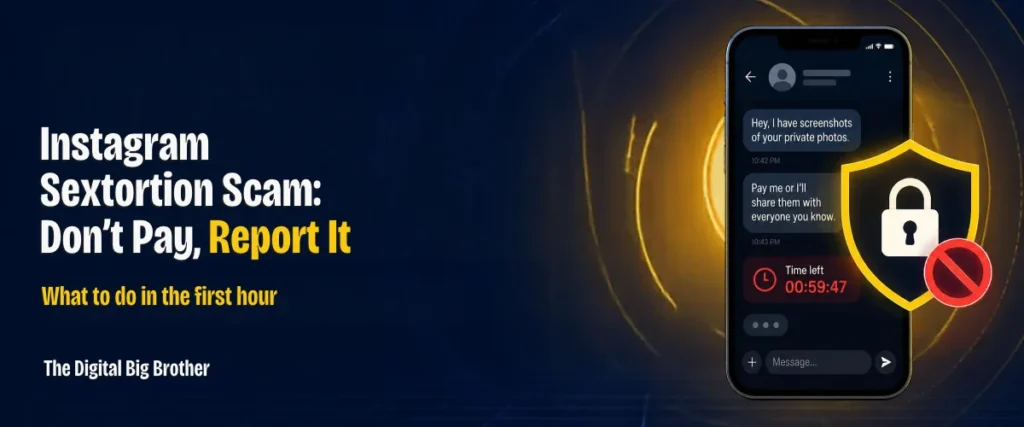
An Instagram sextortion scam is when someone, usually behind a fake profile, gets a private photo or video of you and then threatens to send it your followers unless you pay. If this is happening to you right now, here’s the short answer: don’t pay, don’t delete the chat, and report it at cybercrime.gov.in, or by calling 1930. You are not in trouble, and this can be handled.
This guide shows how an Instagram sextortion scam plays out, how Snapchat differs, and what to do in the first hour. For the basics of how sextortion works, see our Scams section.
Key Takeaways
- Sextortion made up 19% of reported cyber crime cases in India in 2025, so you are not alone.
- An Instagram sextortion scam usually uses your followers list as a threat, so keep your account private.
- On Snapchat, disappearing messages can still be screenshotted or recorded.
- Never pay, because paying almost always leads to a bigger demand.
- Save the evidence, report on cybercrime.gov.in or 1930, and request a takedown.
How Common is Sextortion in India?
In 2025, India logged roughly one sextortion complaint every minute.
That’s more than 5 lakh cases a year. According to The Print, of the 28.15 lakh cybercrime cases reported across India in 2025, 19% were sextortion, second only to investment frauds.
The money is real too. According to Deccan Herald, in 2023, people in Bengaluru alone lost ₹87.45 lakh across 84 reported sextortion cases.
And those are only the people who came forward. Many never do, because shame keeps them quiet, and that silence is exactly what scammers count on.
So if this is happening to you, you are not the first, and you are not “careless.” You were picked by someone who does this all day, using a script that rarely changes. Knowing that script is your best protection, so here’s how an Instagram sextortion scam usually begins.
How an Instagram Sextortion Scam Usually Starts
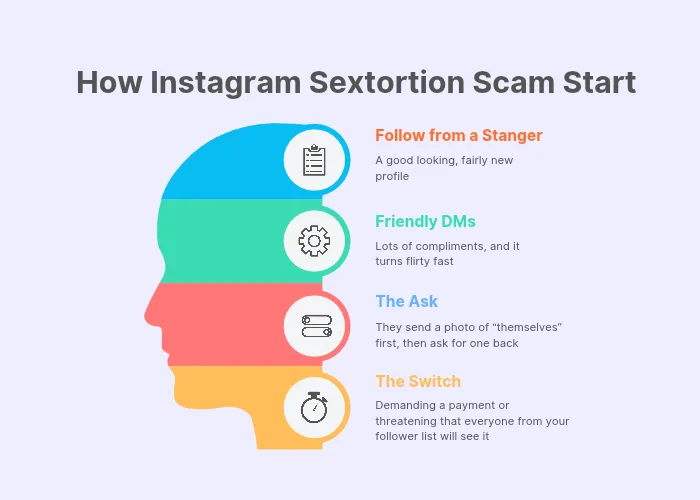
Almost every Instagram sextortion scam follows the same four steps, which makes it easier to spot early:
- A follow from a stranger. Usually a good-looking, fairly new profile claiming to be a student from a nearby college.
- Friendly DMs. Lots of compliments, and it turns flirty fast.
- The ask. They send a “photo of themselves” first, then ask for one back. Or they push for a video call.
- The switch. Once they have your photo or a recorded call, they send a screenshot of your followers list, demanding a payment or threatening that everyone from your follower list will see it.
The person you were chatting with usually doesn’t exist, and the photos are stolen.
🔒 Pro Tip: If someone you’ve never met in person asks for a private photo within the first few days of chatting, treat that as the end of the conversation, not the start of one.
The step 4 is where the pressure starts, and it depends on one thing visible on your profile.
Why your followers list is the scammer’s weapon
In an Instagram sextortion scam, the threat almost always names your followers: clasmates, cousins, parents, etc. That list tells the scammer whose opinion matters most to you.
Meta has said Instagram now hides follower lists from accounts showing scam-like behaviour and blocks screenshots of “view once” photos in DMs. Teen accounts also get an alert when chatting with someone in another country.
These tools help, but they won’t catch every Instagram sextortion scam. Snapchat has its own version, but with a few twists.
How Snapchat Sextortion Are Different?
A Snapchat sextortion scam has the same goal as that of an Instagram sextortion scam, but the app’s design changes how it plays out.
Disappearing messages create false safety. Snaps vanish, so people relax. But anyone can screenshot a snap or record it with a second phone, and the alert comes after the image is saved.
Quick Add brings strangers to you. This “people you may know” feature helps scammers look like someone from your wider circle.
The threat targets your contacts. Scammers threaten to send the image to your Snapchat friends, or find your Instagram account and send it to your friends and followers on the application.
Snapchat now warns teens when a message comes from someone with no mutual friend, someone others have reported, or someone from an unfamiliar region. Teens also step appearing in Quick Add and Search unless they share mutual friends with the searcher.
💡 Pro Tip: When Snapchat warns you that a new contact has no mutual friends or has been reported by others, believe the warning and block the account.
Many Snapchat scams don’t start on Snapchat, though. They start with a username sent from elsewhere.
“Add my Snapchat”: What that username request really means
Moving you to a second app is a classic Instagram sextortion scam move. Someone on Instagram, a dating app, or Telegram sends a Snapchat username and asks you to add them, because disappearing messages make people relax. That rush to switch apps is a red flag on its own.
Some people search online to check whether a sextortion username on Snapchat belongs to known scammer. There is no reliable public list, and scammers change usernames constantly. Instead, note the exact username, report it on the app, and include it in your police complaint.
Whether the scammer stays on one app or moves you across two, the warning signs look much the same.
Red Flags on Both Instagram and Snapchat
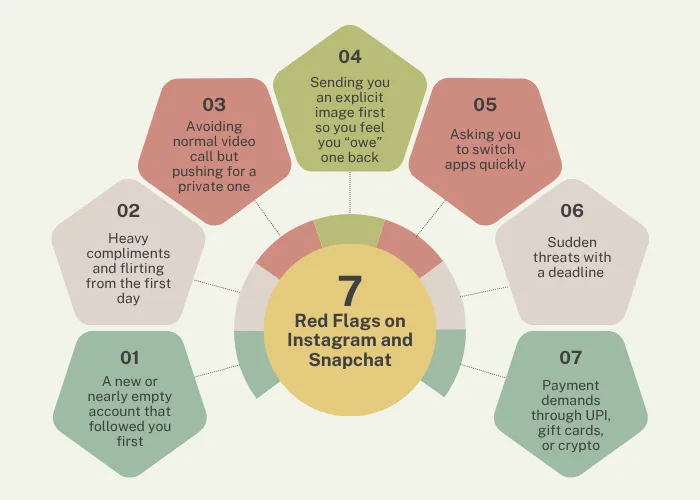
The following are some signs that you must be careful of when talking to someone on apps like Instagram or Snapchat and more. These signs suggest a chat is turning into a sextortion scam, especially when two or three appear together:
Let’s look at some of the red flags that can help you identify an Instagram or Snapchat sextortion scam:
- A new or nearly empty account that followed you first
- Heavy compliments and flirting within the first day
- Avoiding normal video call but pushing for a private one
- Sending you an explicit image first so you feel you “owe” one back
- Asking you to switch apps quickly
- Sudden threats with a deadline
- Payment demands through UPI, gift cards, or crypto
Spotting these helps, but the settings below stop many of these chats from reaching you at all.
Settings to Turn on Today
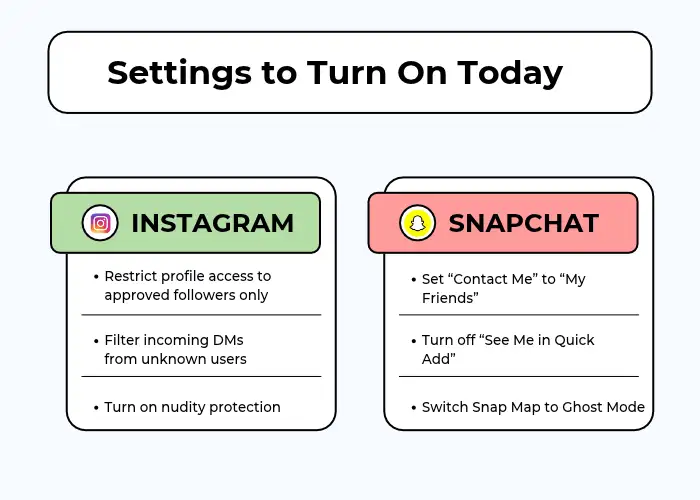
Most Instagram sextortion scams begin with a stranger who can see your profile and message you freely. Limiting both takes hardly five minutes.
Let’s see what setting you need to turn on on Instagram and Snapchat to limit these scams.
On Instagram
The following are the settings you should immediately turn on on Instagram:
- Switch to a private account, so only approved followers can see your posts and followers.
- Limit who can message you, so strangers land in requests section, and not in your inbox.
- Turn on nudity protection in message settings to blur nude images in DMs.
On Snapchat
Turning on the following settings on Snapchat will help reduce the chances of any sextortion scams:
- Set “Contact Me” to “My Friends, so only people you’ve added can reach you.
- Turn off “See Me in Quick Add,” so strangers stop seeing you as a suggestion.
- Switch Snap Map to Ghost Mode (hidden location) if you don’t need it.
🔒 Pro Tip: Menu names change with app updates, so if you can’t find a setting, type its name into the search bar inside the app’s settings page.
These settings lower the risk but they can’t undo what has already happened. If that’s where you are, read on.
Being Blackmailed Right Now? What to do in the First Hour?
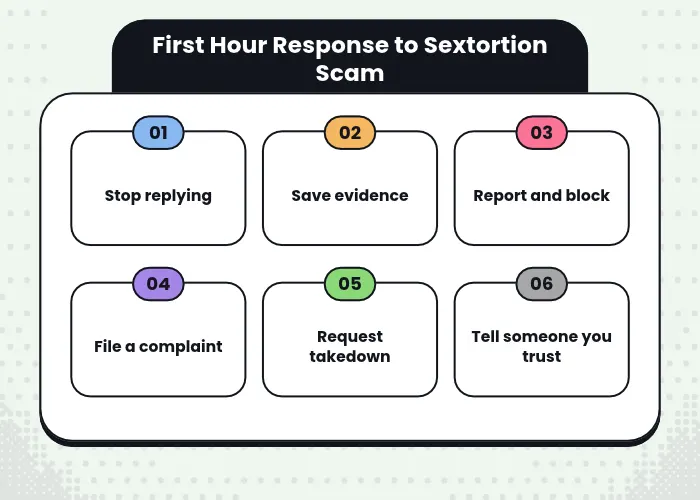
If you’re caught in an Instagram sextortion scam, the first hour matters most. Take a breath, then go through the following steps in order:
- Stop replying and don’t pay. Paying rarely ends an Instagram sextortion scam. It usually brings a second, bigger demand.
- Don’t delete the chat yet. Screenshot the profile, username, every threat, and any UPI ID. This is your evidence.
- Report and block the account in the app. On Instagram, tap the three dots on their profile, then Report. On Snapchat, press and hold their name in the Chat, then Manage Friendship, then Report.
- File a complaint. On cybercrime.gov.in, use the “Report Women/Child Related Crime” section, which handles sexually explicit content. If you have already paid, call 1930 immediately so the transaction can be flagged. Our step-by-step guide to reporting cybercrime in India walks you through the portal.
- Ask for the image to be taken down. If the image was taken before you turned 18, use Take It Down (takedown.ncmec.org). If you were 18 years or older, use StopNCIL.org. Both are free and create a digital footprint of the image so participating platforms can block it, without the photo leaving your phone.
- Tell one person you trust. You don’t have to handle this alone.
Need help now? Call the National Cyber Crime Helpline at 1930 or report at cybercrime.gov.in. If the stress feels like too much, call Tele-MANAS at 14416, the government’s free, 24×7 mental health helpline, available in around 20 languages.
While you work through this, an Instagram sextortion scam can arrest a second of fraudsters.
🛑 Pro Tip: Be careful of anyone online who offers to “hack” the scammer or “delete your photos” for a fee, because that is usually a second scam aimed at the same victims.
These steps can feel heavy if part of you thinks you did something wrong. So let’s be clear about who is at fault.
It’s Not Your Fault, and the Law is on Your Side
Being targeted by an Instagram sextortion scam can leave you feeling guilty, but the law sees it differently. Sending a private photo to someone you trusted is not a crime. Threatening to share it is.
Depending on the facts, police may apply extortion provisions under the Bhartiya Nyay Sanhita (BNS) and IT Act section on privacy violation (66E) and sexually explicit material (67 and 67A). If the victim is under 18, the POSCO Act (India’s child protection law for sexual offences) also applies.
In November 2025, the Ministry of Electronics and Information Technology (MeitY) issued a Standard Operating Procedure on non-consensual intimate images, requiring platforms to remove such content, including morphed or deepfake images, within 24 hours of a complaint.
The Bottom Line: You Can Get Out of This
An Instagram sextortion scam is built to make you panic, pay, and stay quiet. Every part of this guide is about doing the opposite.
If it has already happened, you know the order: stop replying, save the evidence, report it on the appropriate platforms, request a takedown, and tell one person you trust.
The scammer is counting on your silence. Speaking up is what ends it.
Share this guide with a friend, because knowing the script is the best protection.
FAQs: Instagram Sextortion Scam
Q1. Can someone running an Instagram sextortion scam really send my photo to all my followers?
They can try, but many scammers never follow through once you stop responding and report them, which also gets their account removed faster.
Q2. Should I pay if they promise to delete everything?
No. There is no way to check that they deleted anything, and paying usually marks you as someone who will pay again.
Q3. Can I report sextortion anonymously in India?
Yes, cybercrime.gov.in has an anonymous option for certain complaints involving sexually explicit content. For case updates, use “Report and Track” instead.
Q4. Will the police tell my parents?
If you’re 18 or older, the police will deal with you directly. If you’re under 18, a parent or a guardian is usually involved, and that support often helps.
Q5. What id the photo they have is fake or morphed?
Report it the same way. Morphed and AI-generated images fall under MeitY’s takedown procedure, and threatening you with them is still a crime.