A courier delivery scam is a fake parcel message or call, often arriving on WhatsApp or Telegram, that says a package in your name is stuck, unpair, or illegal. The aim is to make you click a link, share details, or pay a fee. The safest first move is to pause and check the parcel on the courier’s own app.
This guide is written for Indian students and anyone who shops or works online. It explains how these scams reach you on WhatsApp, Telegram, or other such channels. It walks through a documented case in which a FedEx-branded call escalated into a “digital arrest” threat, and looks at why such scripts work even on careful & aware people. Then it shares how you can spot such a scam and protect yourself, along with the actions you can take if you have already paid.
Key Takeaways
Courier scams on WhatsApp and Telegram use fake parcel alerts, tracking links, and “customs” calls to rush you into acting.
No real courier transfers you to the police, and no Indian agency arrests anyone over a video call.
Do no click any unknown links, install apps or share OTPs.
If money has already gone, call the 1930 helpline immediately and file report on cybercrime.gov.in.
Being pushed into panic by a scripted call is not your fault, so tell someone you trust and report early.
How a Fake Parcel Scam on WhatsApp or Telegram Reaches You
Chat apps suit scammers because a message from a “delivery agent” feels personal, and a link looks like any other link in a chat. The script comes in a few forms.
- The address or fee message. An unknown number messages you saying your parcel is stuck at a warehouse, and asks you to click a link to update your address or pay a small fee. Similar messages are circulated on channels like WhatsApp and Telegram as well as SMS. PIB Fact Check, the government’s own fact-checking team, has confirmed that indeed these messages are fake.
- A fake tracking page. In the message you get from such scammers there is a link that opens a page built to look exactly like the courier company’’s such as India Post or DHL page. There you are asked to enter your card or UPI details.
- An app you are told to install. Some messages may ask you to download an app to track or reschedule your package. Install an app from outside of the Play Store on an Android and App Store on an Apple device can put everything on your device at risk.
- A call posing as customs or police. You can get a phone call in which the caller will claim they are calling from the Customs department or the police. The scammer will tell you your name and other details and that the package contains something illegal. To resolve the issue, they will share a payment link with you, upon clicking which, they will get access to all your banking details.
Case Study: A FedEx-Branded Call that Became a “Digital Arrest”
These calls have used the names of different couriers over the years, and one of the clearest, best-documented examples used FedEx’s name. This isn’t a story made up to scare you. In November 2023, Bengaluru police arrested a gang running exactly this scam, after it had taken crores of rupees from people across the city. Here’s the blueprint they followed, and pretty much every courier delivery scam uses:
- Someone calls saying they are from FedEx, DHL, or similar courier company, and tells you a parcel booked in your name contains drugs, fake passports, or other illegal items.
- The call is then passed to someone posing as a police or customs officer, usually over a video.
- You are told you are not under “digital arrest:. You have to stay on camera, stay inside your home or room, and not tell anyone what is happening.
- Finally, they ask you to transfer money for “verification”, with a promise that you will get it back as soon as you are cleared.
This is exactly what happened to Mumbai-based comedian Ankita Shrivastav in October 2024. A caller claiming to be from FedEx told her that a courier she had supposedly sent to Iraq contained drugs. Two men posing as police officers kept her on a video call for eight hours, and she approved transactions worth ₹9 lakh. She spoke about the experience publicly and said these scams can happen to anyone, no matter how educated or aware they are.
Has this happened to you? Reporting takes less than five minutes and helps others too.
One woman’s five days: how the pressure builds
A police complaint filed by a woman in Mangaluru in October 2024 shows exactly how this pressure builds, one day at a time.
- 23rd September: A caller claiming to be from DHL told her a parcel in her name held five passports, a laptop, and 400 grams of a banned drug. He said customs would arrest her if she didn’t cooperate, and warned her not to tell anyone.
- 24th September: At 9 AM, a video call instructed her to transfer ₹37 lakh through a bank transfer to “prove” she was innocent.
- 26th September: She was told an “auditor” needed to check her assets, and was asked for another ₹2.3 lakh, with a promise that everything would come back with interest.
- 28th September: The callers stopped picking up, but by then she had lost close to ₹40 lakh.
Here’s the one fact worth remembering about any digital arrest scam. The Indian cybercrime unity, called I4C has said that no police officer, no customs official, and no judge ever arrests anyone over a video call. That is simply not how a real arrest works, no matter how convincing the caller sounds.
Why These Scams Work, Even on Careful People
Almost everyone is waiting for a delivery. Students order books and phone accessories, families send gifts, and parcel updates land on mediums like WhatsApp. A message about parcel just feels like a part of the ordinary life, so you open the message and tap on links without even thinking twice.
But the thing that turn these messages into digital arrest scams is “fear”. When someone calls you and tells that drugs have been found in your parcel, fear and panic are the obvious first reactions. Scammers use this psychological trick to scam you. These fraudsters keep victims confined to one room and make them stay on camera for hours, so there’s never a moment to stop, calm down, and think clearly.
Upon analysing several digital arrest cases, three tricks come out in common: a deadline, an order to tell nobody (secrecy), and a demand to stay on camera. Each of these tricks takes away your chance to pause and check what’s actually happening.
💡 Pro Tip: Remember this one rule: if a caller ever asks you to keep something secret, that alone is reason enough to hang up.
What the Numbers Say About Digital Arrest and Courier Scams
This is not a small or rare problem. Digital arrest cases in India have jumped from about 40,000 in 2022 to well over 1.2 lakh in 2024.
These numbers cover every kind of digital arrest scams, and not just the courier ones. But courier or delivery calls are generally the first steps that lead to digital arrest scams.
But, according to the Ministry of Home Affairs, after this spike of over 400% in 2024, the numbers have dropped down to around 17,000 in 2025. This drop in cases is a good sign, but an MHA official says the cases are still coming in, and the money involved is huge. This is not a problem that has gone away.
How to Spot a Courier Scam
You don’t need to be an expert to catch most of these scams. You need to pay attention to only two things: knowing the warning signs, and knowing exactly how a genuine courier behaves.
Let’s discuss them in detail below.
Red flags in a message or call
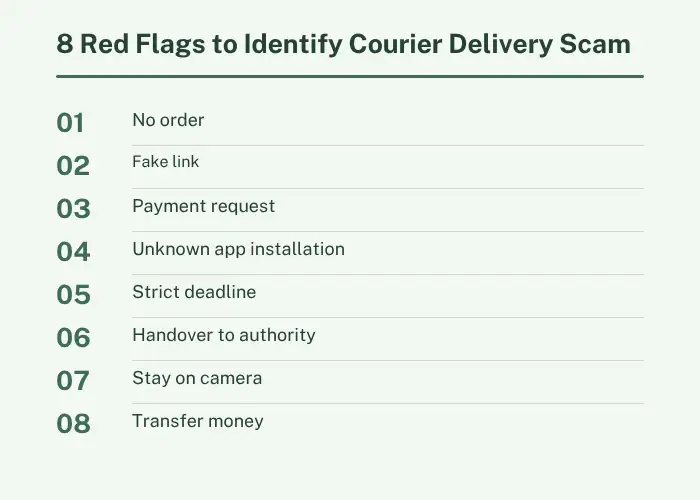
If you notice even one of the following, then stop immediately and check before you do anything:
- You didn’t order anything, or the message doesn’t mention a real order, seller, or tracking number.
- The link doesn’t lead to the courier’s official website. For example, a genuine India Post message will contain a link that ends with .gov.in.
- You are asked to pay a small fee, or to share an OTP, UPI pin, card or banking details, just so the parcel can be delivered to you.
- You are asked to install an app to track or reschedule the parcel delivery.
- There is a strict deadline attached, like “update your address within 48 hours”.
- A “courier executive” hands you over to someone posting as a “police or customs officer”, often on a video call.
- You are told to stay on camera, and not tell anything to your friends or family.
- You are asked to transfer money to “prove you innocence” or to get “verified”.
Genuine courier or scam: side by side
A real courier and a scammer act very differently, and you can check each of these for yourself in under a minute.
| Check | What a real courier does | What a scammer does |
| Where you verify | Your tracking number works on the courier’s own website or app | The message pushes you to a link, phone number, or an app inside the chat |
| Address update | No courier company will ever ask you to update your address through a link | A link asks you to fix you address within 48 hours or the parcel will be returned |
| Personal details | No courier company will ever ask for your personal details through unsolicited calls, mail, or email | You are asked to share OTP, UPI pin, card or banking details |
| Police or customs | A courier company will never hand you over to the police | Your call is passed to a “cyber cell” or a “customs officer” |
| Money | Any fee is for a parcel you are actually expecting, and you can confirm it yourself on the courier’s real app or website | You are told to transfer money to prove your innocence or to avoid arrest |
How to Protect Yourself from these Scams
Protecting yourself from courier delivery scams comes down to three things: getting a few settings right before a scam ever reaches you, knowing exactly what to do the moment one does, and knowing how to help someone else who’s caught up in one.
Let’s understand them in detail below.
Settings and habits that help
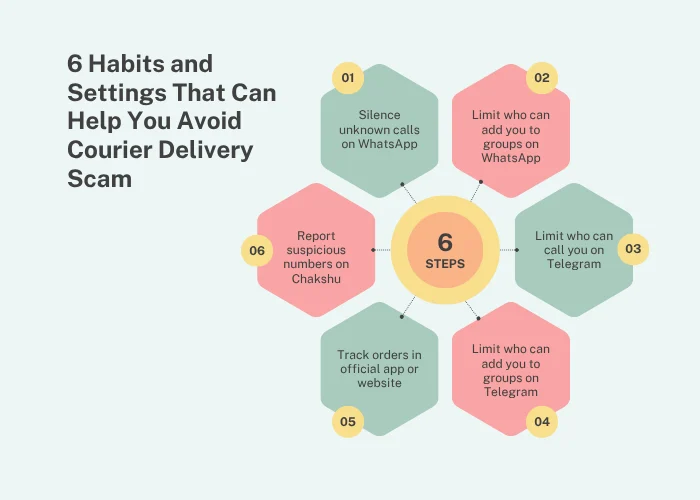
A few simple settings in your phone can make these messages and calls much easier to ignore. Each one takes under a minute to turn on, though the exact menu names might look different depending on your phone.
- On WhatsApp, silence unknown callers. Go to Settings > Privacy > Calls, and turn on “Silence unknown callers.” Once you turn on this setting, calls from unknown numbers will stop ringing, though they will still show up in your Calls tab.
- On WhatsApp, limit who can add you to groups. Go to Settings > Privacy > Groups, and choose “My Contacts”. WhatsApp’s default settings is that anyone who has your number can add you to group, even if they are a complete stranger.
- On Telegram, limit who can call you. A delivery scam on Telegram in India can start with a call from someone you have never spoken to. To control that, go to Settings > Privacy and Security > Calls, and set “Who can call me” to “My Contacts” or “Nobody”.
- On Telegram, limit who can add you to groups. In the same Privacy and Security menu, open “Groups & Channels” and set “Who can add me” to “My Contacts” or “Nobody”, so strangers can’t add you into fake shopping or job groups.
- Track every order inside the official app or website only. If you shopped through Amazon or Flipkart, check its status inside the official app or website only. Never do through a link sent in a chat message.
- Report suspicious numbers on Chakshu. Indian government’s Sanchar Saathi website has a section called Chakshu, where you can report suspected fraud calls, SMS, and WhatsApp messages before any money is lost. If you have already paid, then call 1930 immediately and report on cybercrime.gov.in.
What to do the moment a fake message or call arrives
Follow the below steps the moment you receive a fake message or call:
- Don’t click, reply, or call back. Leave the link alone, add don’t dial any number given in the message.
- Check the parcel yourself. Open the courier’s official app or website, or the shopping app you ordered from, and enter the tracking number there to check its progress.
- Hang up the moment it turns into a “police or customs” call. No courier ever transfers your call to the police, and no one in India can be arrested over a video call.
- Share nothing. No OTP, no UPI pin, no card details, no Aadhaar copy. Don’t install any app, and never share your screen with anyone.
- Save it, then block, and report it. Take screenshots first. Then block and report the number inside WhatsApp or Telegram, and report them by emailing all proofs to reportphishing@cybercrime.gov.in.
- Tell someone you trust. The courier delivery scams rely entirely on you staying quiet. A two-minute conversation with a friend or parent is often the only defence you actually need.
Want the full picture on staying safe online? Read our complete guide.
If someone in your family is on the call right now
The first thing you need to do is stay calm. Next you need to focus only on getting them off the call. Don’t waste time arguing about whether the caller sounds convincing; just get the call to end.
- Ask them to hang up or leave the video call. A real officer or courier can always call back later. No agency in India arrests anyone over a video call, ever.
- Speak to them in person, or call them from a different phone. In these scams, victims are told to stay on camera and tell no one. Hearing your voice might be the exact thing they need to realise something is wrong.
- If money has already moved, call 1930 and the bank. Don’t wait to first prove the caller is fake.
- Don’t ask them how they fell for it. Never ask them how they fell for the scam. It is not what they need in their current situation. Instead be kind and help them find a solution to the issue.
If you Already Paid or Shared Details
Move as fast as you possibly can. A Ministry of Home Affairs official says there is a “golden hour period” in which prompt action can still block the stolen money. So every hour matters.
The following are somethings you can do if you have already paid or shared your details:
- Call the cybercrime helpline number, 1930. This is the central helpline number that I4C asks people to use to report cyber crime. Keep the amount, the time, your transaction ID, and the receiving account details ready before you call.
- File a complaint on the national portal. Go to the national cyber crime reporting portal, choose “financial fraud” and attach your screenshots.
- Call your bank. Ask them to block your card, your UPI, and your net banking, and to log the fraud complaint on their end too.
- Keep every evidence. Don’t delete the chat, the group, or the call log. Save phone numbers, profile names, links, and payment receipts.
- Secure your phone. If you installed an app or shared cared details or PIN, uninstall the app (but keep a screenshot of it), change your banking passwords and PINs, and get your card blocked.
However, do not assume that you’ll automatically get a full refund. If money leaves your account purely because of someone else’s fraud, and you report it within the golden period, you may not have to bear that loss yourself.
But if you transferred the money yourself, even under a threat, you might not get the full amount recovered.
Lost money in the last few hours? Call 1930 right now – the sooner you report it, the better the chance of freezing the transfer.
Conclusion
A courier delivery scam works because a message about a parcel looks like ordinary life, and a “police” call sounds like a real emergency. The defence stays the same every single time: pause before you click or pay anything, track your parcel on courier’s official app, and end any call that asks you to stay on camera or keep quiet. No courier ever transfers you to the police, and no one in India can be arrested over a video call.
FAQs: Courier Delivery Scam
Q1. Is a FedEx call about illegal items in my parcel real?
No, a real courier never transfers you to the police or asks you to pay to “clear your name.”
Q2. Can police arrest me over a WhatsApp video call?
No, none of the Indian law enforcement agencies can arrest you over a video call.
Q3. What should I do first with a fake parcel message?
Don’t click anything, and check the parcel status on the courier’s official app or website.
Q4. Who do I call if I have already lost money?
Call the 1930 helpline right away, and then file a complaint on cybercrime.gov.in.
Q5. How do I report a scam number on WhatsApp or Telegram?
Block and report it in the app, then report it on the national cyber crime reporting portal because blocking alone will not get you your money back.